
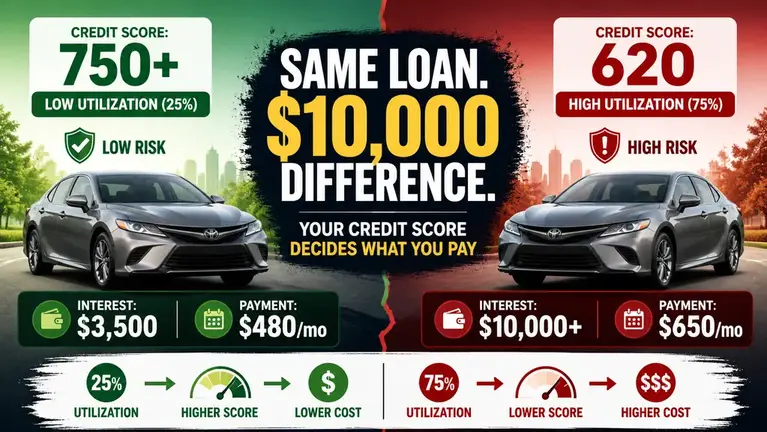
- What credit utilization is, how it's calculated per card and overall — and why it's 30% of a FICO Score.
- Who gets caught out most: people who pay in full every month but use a lot of their limit, because the balance is reported at statement close, not after the payment.
- What utilization people at each score level actually carry, according to Experian — and the quickest ways to bring yours down before you apply for credit.
Credit utilization is the share of your credit card limits you’re using, and lower is better: the CFPB says experts advise staying at no more than 30%, and people with the highest scores average in the single digits. It’s measured from the balance your card issuer reports — usually your statement balance — so you can pay in full every month and still show high utilization.
That second point is why so many people see their score drop despite never missing a payment. Here’s how utilization is measured, what level is too high, and how to bring it down before your next application.
How Is Credit Utilization Calculated?
The formula: (total credit card balances ÷ total credit card limits) × 100
If you have one card with a $10,000 limit and a $7,500 balance, your utilization is 75%. With two cards — $3,000 on a $5,000 limit and $0 on a $5,000 limit — your overall utilization is 30%, but the first card is at 60% on its own.
Both numbers matter. Experian notes that overall and per-account utilization can affect credit scores, and scoring models may consider the highest utilization on any single card. One maxed-out card can hurt even when the total looks fine.
Utilization sits inside “amounts owed,” which myFICO says makes up 30% of a FICO Score — second only to payment history. Only revolving accounts (credit cards and lines of credit) count; installment loans like auto loans, student loans and personal loans don’t.
What Utilization Do People Have at Each Credit Score Level?
The clearest benchmark is what people at each score level actually carry. Experian’s data shows a steep pattern:
| FICO Score range | Average credit card utilization |
|---|---|
| Exceptional (800–850) | 7.1% |
| Very good (740–799) | 15.2% |
| Good (670–739) | 38.6% |
| Fair (580–669) | 61.4% |
| Poor (300–579) | 80.7% |
Source: Experian, Q3 2024 data.
This doesn’t mean utilization alone sets your score — payment history, account age and the other factors matter too. But it shows where people at each level tend to sit. The jump between Good and Very good is the most striking: average utilization falls by more than half.
Is 30%, 50% or 70% Credit Utilization Bad?
30% isn’t a cliff, but it’s the commonly cited ceiling. Experian describes 30% as where utilization “starts to have a more pronounced negative effect.” Under 30% is generally fine; under 10% is better.
50% is bad for your score. It’s well above the 30% guideline, and in Experian’s data it sits between the average for Good scores (38.6%) and Fair scores (61.4%) — not with the high scorers.
70% is a strong negative signal. It’s above the Fair-range average and moving toward the Poor-range average of 80.7%. At that level, a lender sees little room left on your cards, and approvals and rates start to reflect it.
At or near 100% on any card, expect the biggest hit — even if your overall utilization is lower and every payment is on time, because models can look at the highest single-card ratio.
Why Can Utilization Look High Even If You Pay in Full?
Because the bureaus see your balance before you pay it.
Card issuers generally report each account’s balance at the end of the statement period. Experian explains that because of this timing, “you may have a high utilization rate even if you pay your bill in full.”
Example: your statement closes on the 15th with a $6,000 balance on a $10,000 limit, and you pay it all on the 25th. The bureaus already recorded $6,000 — 60% utilization — even though you never paid a cent of interest.
The fix: make a payment before the statement closing date, so a lower balance gets reported. Many people pay mid-cycle, or a few days before the closing date, then pay the remaining statement balance by the due date. Your closing date is printed on your statement and usually shown in your card’s app.
How Fast Does Lowering Utilization Raise Your Score?
Often within a billing cycle or two. Experian notes that many scoring models use only the most recently reported balances and limits, so once a lower balance is reported, the improvement can show up quickly. That makes utilization the fastest lever you have — late payments take years to fade; a lower reported balance takes weeks.
There’s one caveat. Some newer models, including FICO 10 T and VantageScore 4.0, use trended data — how your balances have moved over time — so a long stretch of high utilization may take longer to shake off under those models. Paying down and staying down is what counts.
Why Does Utilization Stay High When You Carry a Balance?
If you’re not paying in full, interest is the reason the number won’t budge.
The Federal Reserve’s G.19 release put the average rate on credit card accounts assessed interest at 22.36% for August 2026. At roughly that rate, a $5,000 balance accrues about $91 of interest a month. On a $125 payment, only about $34 reduces the balance — so utilization barely moves.
That creates a loop: high balance → high utilization → lower score → higher rates → slower payoff → high balance. The mechanics of why card payments go mostly to interest are covered in why your credit card debt isn’t going down, and the credit card minimum payment calculator shows how long a specific balance takes to clear.
What Does High Utilization Cost on Your Next Loan?
A lower score from high utilization puts you in a higher rate tier, and the tier gap is large: at Experian’s Q2 2026 averages, a subprime new-car borrower pays nearly $8,000 more interest than a super prime borrower on the same $30,000 loan. The full tier-by-tier table is in interest rates by credit score. High utilization is also one of the reasons lenders list on denial notices — if that’s happened to you, see why loan applications get rejected before reapplying.
Use the estimator below to get a rough sense of what your own utilization might cost on a loan:
Utilization Cost Estimator
Enter your numbers to see exactly what your current utilization is costing you — and how much you could save.
Current
If Under 30%
⚠ Rough illustration only. Utilization is one of five score factors, so no utilization level maps to a fixed score — the score ranges and APRs here are approximate tiers, not published averages. Actual rates vary by lender, loan type, and your full credit profile.
How Do You Lower Your Credit Utilization?
There are three ways, and they work best combined.
1. Pay balances down before the statement closes. This is the fastest. Even moving from 70% to 40% can show up within one or two reporting cycles. If you pay in full already, just shift the timing of your payment earlier.
2. Raise your available credit without spending more. A higher limit lowers the ratio: $2,000 on a $5,000 limit is 40%; on an $8,000 limit it’s 25%. Some issuers run a hard inquiry for a limit increase, and opening a new card adds one too — so treat this as a complement to paying down balances, not a substitute. Avoid closing old cards with zero balances, which removes their limits from the total and pushes utilization up. If you only have one card with a small limit, every purchase swings your ratio; building credit without a credit card — with a credit-builder loan or rent reporting, for example — adds history that doesn’t depend on utilization.
3. Move revolving debt to installment debt. If interest keeps the balance stuck, a personal loan or balance transfer can change the math. A personal loan used to pay off cards takes that balance out of your utilization entirely, and if the APR is lower, the monthly interest drops too. This guide covers whether consolidating with a personal loan makes sense, including fees and the credit score impact.
Frequently Asked Questions About Credit Utilization
Does credit utilization matter if I pay my card in full every month?
Yes. Card issuers generally report your balance to the credit bureaus at the end of each statement period — not after you pay. If your statement balance is high, your utilization looks high even if you pay in full days later. The fix: pay down the balance before the statement closing date, not just before the due date.
Is 50% credit utilization bad for my credit score?
Yes. 50% is well above the 30% ceiling the CFPB says experts recommend. In Experian's data, people with Good FICO Scores (670–739) average 38.6% utilization and people with Fair scores (580–669) average 61.4% — so 50% sits between those two groups, not with the high scorers.
Is 70% credit utilization bad?
Yes. In Experian's data, 70% is above the average for people with Fair FICO Scores (61.4%) and closer to the Poor range average (80.7%). At that level a lender sees little room left on your cards, and it can weigh on both your score and the rate you're offered.
How fast does lowering my utilization improve my credit score?
Often within one billing cycle. Many scoring models only look at the most recently reported balances and limits, so once your issuer reports a lower balance, the change can show up quickly. Some newer models, such as FICO 10 T and VantageScore 4.0, also consider trended data, so a long history of high balances can take longer to fade under those models.
Does utilization apply to each individual card or just the total across all cards?
Both. Experian notes that overall and per-account utilization can affect credit scores, and scoring models may look at the highest utilization on any single card. One maxed-out card can hurt even if your total looks fine.
What is the ideal credit utilization ratio?
Lower is better. The CFPB says experts advise staying at no more than 30% of your total limit, and Experian says a good rate is ideally in the single digits. In Experian's data, people with FICO Scores of 800–850 average 7.1% utilization.
Will requesting a credit limit increase lower my utilization?
Yes, if your balance stays the same. If your limit goes from $5,000 to $8,000 and your balance stays at $2,000, utilization drops from 40% to 25%. Some issuers do a hard inquiry for the request, which can cause a small temporary dip, so it works best alongside paying down balances.
Does paying off a credit card with a personal loan lower my utilization?
Yes. Personal loans are installment debt, not revolving debt, so they don't count toward credit card utilization. If a $6,000 card balance was driving 60% utilization, moving it to a personal loan can drop revolving utilization close to zero — as long as you don't run the card balance back up.
Related reading:
- Interest rates by credit score
- Why your credit card balance isn’t going down
- How simple vs. compound interest works
- Why your credit score isn’t improving, and which factors actually move it
This article is for informational purposes only and does not constitute financial advice. Utilization averages are from Experian (Q3 2024 data); interest examples are our own calculations.