
- What interest rate each credit score tier actually gets, using Experian's Q2 2026 averages — and the dollar gap between tiers on the same loan.
- Who pays the most for a lower score: borrowers in the near prime and subprime tiers, where one tier can add thousands in interest before the loan is signed.
- What moves a score into the next tier, how long it realistically takes, and what that one move saves on a real loan.
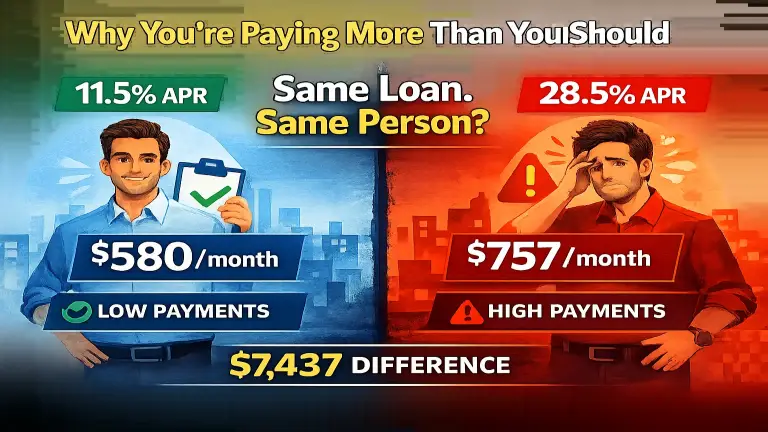
The lower your credit score, the higher the interest rate lenders offer, and the gap between tiers is large. In Experian’s Q2 2026 auto loan data, new-car buyers with super prime scores (781 and up) averaged a 4.41% APR, while subprime borrowers (501–600) averaged 13.52% — about $7,950 more in interest on the same $30,000, five-year loan.
That gap is not a penalty or a mistake. Lenders price risk, and your credit score is the number they use to measure it. The CFPB puts it plainly: scores are used to decide whether you’re approved and “to determine the interest rate and credit limit you receive.”
Average Interest Rates by Credit Score (Q2 2026)
The table below shows average auto loan APRs by credit score tier, from Experian’s State of the Automotive Finance Market data for Q2 2026 (published September 10, 2026; Experian uses VantageScore 4.0 for these tiers). The interest columns are our own math on a $30,000 new-car loan and a $20,000 used-car loan, both over 60 months.
| Credit score tier | New car APR | Total interest, $30,000 new | Used car APR | Total interest, $20,000 used |
|---|---|---|---|---|
| Super prime (781–850) | 4.41% | $3,484 | 6.29% | $3,362 |
| Prime (661–780) | 6.15% | $4,925 | 8.81% | $4,800 |
| Near prime (601–660) | 9.71% | $7,988 | 13.93% | $7,878 |
| Subprime (501–600) | 13.52% | $11,436 | 19.10% | $11,195 |
| Deep subprime (300–500) | 16.11% | $13,878 | 21.62% | $12,884 |
Two things stand out. First, the steps between tiers aren’t even: the jump from prime to near prime costs about $3,060 on the new-car loan, while the jump from super prime to prime costs about $1,440. Second, the used-car column shows the same pattern at a higher starting point — a deep subprime used-car buyer pays more interest on $20,000 than a prime new-car buyer pays on $30,000.
What about personal loans? No credit bureau publishes average personal loan rates broken out by score, so treat any “personal loan rate by credit score” chart you see as a lender or marketplace estimate. For a baseline, the Federal Reserve’s G.19 release put the average commercial bank rate on a 24-month personal loan at 11.90% for August 2026. Personal loans are unsecured, so lenders usually spread rates across tiers even more widely than auto lenders do. FICO’s own loan savings calculator shows current rates by FICO Score range for several loan types if you want a second reference point.
To see what a tier gap means for the loan you’re actually considering, plug in your own numbers:
Loan Cost Calculator
⚠ Estimates only. The APR filled in for each score tier is an illustrative personal-loan figure, not a published average — no credit bureau publishes personal loan rates by score. Replace it with a real quote when you have one; your actual rate depends on the lender, loan amount, and your full credit profile.
The calculator starts at a 680 score. Slide it down to 620 and watch the total interest line — that change is the price of one tier.
What Is a Credit Score and How Does It Set Your Rate?
A credit score is a three-digit number, typically ranging from 300 to 850, that estimates how likely you are to repay borrowed money based on your past credit behavior. The most widely used model is the FICO Score; VantageScore is the other common model (it’s the one behind the Experian table above). Lenders may use different versions, which is why the score you see in an app may not be the exact number a lender pulls.
The score isn’t an opinion. It’s a calculation from your credit report. FICO states that its scores are calculated only from the information in your credit report — so it’s not a measure of your income, your savings or your job. Two people with identical salaries can be 150 points apart.
What Are the Five Factors That Build Your Credit Score?
According to myFICO, a FICO Score is built from five categories in your credit report:
Payment history (35%) — Whether you’ve paid every account on time. One missed payment doesn’t destroy a score, but a pattern of late payments, defaults or collections does serious damage. If you’ve just missed one, here’s what actually happens in the first 30 days — and what to do immediately.
Amounts owed — credit utilization (30%) — How much of your available revolving credit you’re using. If your card limits total $10,000 and your balances total $6,500, your utilization is 65%. The CFPB notes that experts advise keeping it at no more than 30% of your total limit. Why high utilization drags a score down even when you pay on time — and why paying in full can still show a high number — is covered in how credit utilization works. If the balances themselves won’t shrink, that’s how minimum payments are designed.
Length of credit history (15%) — Longer histories give lenders more data. This is why closing old accounts, even unused ones, can work against you.
Credit mix (10%) — A profile with both revolving credit (cards) and installment loans (auto, student, personal) tends to score better than one with only one type. Consolidating card balances into a personal loan changes both your mix and your utilization at once — see whether the APR math holds up.
New credit (10%) — Each application adds a hard inquiry. Several in a short window can signal financial stress and put mild downward pressure on your score.
No card, or a thin file? You can still build history in the payment and mix categories — here are the ways to build credit without a credit card.
What Happens to Your Rate When You Move Up One Tier?
Moving up a single tier usually cuts your offered APR by several points, and that turns straight into dollars.
Using the Experian Q2 2026 new-car averages, a borrower who moves from near prime (601–660) to prime (661–780) sees the average rate fall from 9.71% to 6.15%. On the same $30,000, 60-month loan:
- Near prime: about $633/month, $7,988 total interest
- Prime: about $582/month, $4,925 total interest
That’s roughly $3,060 saved without touching the loan amount or term.
For a borrower near the bottom of a tier, that move can be realistic within 12–18 months of on-time payments and lower card balances. Utilization is usually the fastest lever, because most scores look at the balances most recently reported. Late payments take longer: they stay on your report for up to seven years, though their effect fades over time.
An improved score is also the moment to revisit existing card debt — borrowers who couldn’t get a competitive personal loan rate a year ago may now qualify. Here’s how to check whether consolidation now works in your favor.
Where Does Your Credit Score Follow You Beyond Loan Applications?
The same tier system shows up well beyond personal and auto loans.
| Situation | How your credit score affects it |
|---|---|
| Mortgage | The biggest long-term impact — a tier difference can mean tens of thousands of dollars over 30 years |
| Auto loan | Same car, same dealership — very different monthly payment depending on tier (see the table above) |
| Credit cards | Determines approval, limit and rate — lower limits make utilization harder to control |
| Apartment rental | Many landlords run credit checks; weaker profiles may be rejected or asked for a bigger deposit |
| Utility accounts | Some providers require a deposit below a certain credit threshold |
| Insurance premiums | Auto and homeowners insurers in most U.S. states use credit-based insurance scores in pricing |
| Employment | Some finance and government roles review credit history during hiring |
Why Do Lenders Charge Lower Scores So Much More?
Lenders charge more to borrowers whose repayment looks less predictable, because some share of those loans won’t be repaid in full. The higher rate is a buffer against that expected loss, spread across everyone in the tier.
That’s why the gaps in the table aren’t even. Default rates climb faster as scores drop, so the price of each tier climbs faster too — the step from near prime to subprime costs more than the step from super prime to prime.
Credit scores replaced a more subjective process in which individual loan officers made judgment calls. The system isn’t perfect, but it follows documented rules, and those rules can be learned and worked with.
What Do the Most Common Credit Score Assumptions Cost You?
“Income is the main factor.” Income isn’t part of the score at all. Lenders may weigh it separately, but your credit profile is the first gate, and it sets the rate tier you’re priced in.
“All lenders evaluate the same way.” Lenders use different score versions and different cutoffs. The same applicant can be approved by one and declined by another. Knowing your tier tells you which products you’re realistically positioned for before you take a hard inquiry.
“A single missed payment won’t matter much.” Payment history is 35% of a FICO Score. A payment 30 days late can cause a noticeable drop, and the stronger your score going in, the more a single miss costs.
“My score is fine because I haven’t been rejected.” You may have been approved at a rate one tier higher than a stronger profile would get. The cost is still there — it’s just less visible than a rejection letter.
What’s the Difference Between a Credit Report and a Credit Score?
Your credit report is the full record — every account, payment, inquiry and public record — kept separately by Equifax, Experian and TransUnion. Reports can differ between bureaus because not every lender reports to all three.
Your credit score is a number calculated from that report. If the report has errors — duplicate accounts, wrong balances, negative items that should have aged off — the score reflects them too.
Under the Fair Credit Reporting Act, you’re entitled to free copies of your credit reports, and all three bureaus now permanently offer free weekly reports through AnnualCreditReport.com. Pull all three before you apply for anything, so you know your tier — and have time to dispute errors — before a lender prices you.
What to Do Next Based on Your Score Tier
You’re in the prime or super prime tier (roughly 661+) → Shop rates with prequalification (soft pulls) before submitting full applications, and keep utilization low in the month or two before you apply.
You’re near prime or below (under about 660) → The fastest levers are lowering card balances before your statement closing dates, paying every account on time for 6–12 months, and disputing report errors. Here’s how utilization affects your score and how to lower it quickly. If your file is thin, these credit-building options don’t require a credit card. If you’re already doing those things and the score still isn’t moving, here’s what usually holds it back.
Your card balances aren’t shrinking despite monthly payments → The issue is usually the interest rate and minimum payment design, not your consistency. See why credit card debt isn’t going down before choosing a path.
You’ve already been turned down → Don’t reapply immediately; a second hard inquiry makes the picture worse. Find out what triggered the rejection and what to fix first.
Frequently Asked Questions
What interest rate can I get with my credit score?
It depends on the loan type and lender, but each lower tier pays more. In Experian's Q2 2026 auto loan data, new-car borrowers averaged 4.41% APR with super prime scores (781+), 6.15% with prime (661–780), 9.71% with near prime (601–660), 13.52% with subprime (501–600) and 16.11% with deep subprime (300–500).
How much does a lower credit score cost on the same loan?
On a $30,000, 60-month new-car loan at Experian's Q2 2026 average rates, a super prime borrower (4.41%) pays about $3,484 in total interest, while a subprime borrower (13.52%) pays about $11,436 — roughly $7,950 more for the identical loan.
What are the five factors that make up a credit score?
According to FICO: payment history (35%), amounts owed (30%), length of credit history (15%), new credit (10%) and credit mix (10%). Payment history and amounts owed together account for nearly two-thirds of the score.
How much can improving your credit score actually save you?
Moving up one tier can save thousands on a single loan. Using Experian's Q2 2026 new-car averages, going from near prime (9.71%) to prime (6.15%) on a $30,000, 60-month loan cuts total interest from about $7,988 to about $4,925 — a saving of roughly $3,060 with no change to the amount or term.
Does my income affect my credit score?
No. FICO says its scores are calculated only from the information in your credit report, and income isn't in your credit report. Lenders may look at income separately when they decide whether to approve you, but it doesn't change the score itself.
What's the difference between a credit report and a credit score?
Your credit report is the full record of your accounts, payments and inquiries, kept separately by Equifax, Experian and TransUnion. Your credit score is a number calculated from what's in that report. You can have an acceptable-looking score and still have errors or outdated negative items on the report that a lender will see.
Where can I get my credit report for free?
Under the Fair Credit Reporting Act, every U.S. consumer is entitled to free copies of their credit reports. All three bureaus now permanently offer free weekly access through AnnualCreditReport.com.
Does my credit score only matter when I apply for a loan?
No. It follows you into mortgages, auto loans, credit card approvals and limits, apartment rentals (many landlords run credit checks), utility deposits, insurance premiums in most U.S. states, and even employment screening for some roles.
This article is for informational purposes only and does not constitute financial advice. Average rates are from Experian (Q2 2026) and the Federal Reserve (August 2026); total-interest figures are our own calculations on standard amortizing loans. Your actual rate will vary by lender and credit profile.