
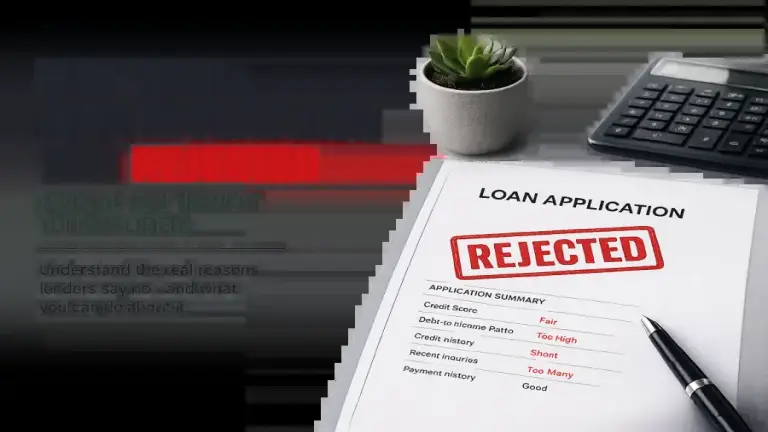
- The top reasons loan applications get rejected — high debt-to-income, credit history, recent inquiries, unverifiable income and paperwork mismatches — and how to tell which one hit you.
- Who gets blindsided most: applicants with a decent score who didn't know the lender was weighing their DTI, inquiries or documents just as heavily.
- What your adverse action notice must tell you under ECOA and the FCRA — and how to use it to fix the right thing before you reapply.
Most loan applications are rejected for one of a handful of reasons: a debt-to-income ratio above the lender’s limit, a weak or thin credit history, too many recent applications, income the lender can’t verify, or a mismatch in your paperwork. You don’t have to guess which one it was — federal law requires the lender to tell you, in a written adverse action notice.
The best public data on denial reasons comes from mortgage lending, where lenders must report why they said no. In the CFPB’s review of 2018 HMDA data, the four most-cited denial reasons were credit history, debt-to-income ratio, collateral and an incomplete application — and DTI was “overwhelmingly” the most common reason home-purchase applications were denied. Personal and auto lenders don’t publish the same data, but they check the same things.
The top reasons, and where each is covered below:
- Debt-to-income ratio too high — the most common trigger, even with a good score
- Credit history problems — utilization, late payments, a thin file
- Too many recent hard inquiries — often from applying again right after a denial
- Negative marks — collections, charge-offs, bankruptcy
- Income that can’t be verified — common for freelancers and recent job changes
- Document mismatches — names, addresses, employer details
Which Reason Was Yours? Run the Denial Checker
Go through this checklist with your application in front of you. Every box you can’t honestly check is a likely reason you were turned down — and the place to start before reapplying.
Application Readiness Checklist
Check every box that applies. Unchecked items are likely where your application fell short.
What Your Adverse Action Notice Must Tell You
The denial letter is the single most useful document you have right now, and most people throw it away. Three federal laws decide what has to be in it.
The Equal Credit Opportunity Act (ECOA) and Regulation B. Under Regulation B, § 1002.9, a lender generally has to notify you within 30 days of receiving a completed application. A denial notice must be in writing and must either state the specific reasons for the decision or tell you that you can request them. Vague answers don’t count: the rule says that saying you failed the lender’s “internal standards or policies” is not enough. The FTC’s page on the ECOA has the full text of the law.
The Fair Credit Reporting Act (FCRA). If the decision was based even partly on your credit report, the CFPB explains that the lender must also give you the numerical credit score it used, the key factors that hurt that score, and the name and contact details of the credit bureau that supplied the report. You also have the right to a free copy of that report if you ask within 60 days of the notice. The law itself is on the FTC’s FCRA page.
What to do with the notice:
- Match each listed reason to a section below. “Excessive obligations in relation to income” means DTI. “Limited credit experience” means a thin file. “Too many recent inquiries” means timing.
- Request the free report from the bureau named in the notice and check it for errors. If something is wrong, dispute it with that bureau.
- Note the score and key factors. They tell you which part of your credit profile to work on first.
Does the denial itself hurt your credit? No. Experian notes that a declined loan doesn’t appear on your credit report. The hard inquiry from the application does, and it stays for two years — so the real damage comes from applying again and again, not from the first no.
Is Your Debt-to-Income Ratio Too High?
This is the reason applicants are least prepared for, and the one the mortgage data shows most often.
Your debt-to-income ratio (DTI) is your total monthly debt payments divided by your gross monthly income. Lenders use it to judge whether you can take on another payment. Many lenders want DTI below 43% — a figure that came from the CFPB’s earlier Qualified Mortgage rules for home loans and is widely used as a benchmark elsewhere. Many prefer 36% or lower, and some set tighter limits by loan type.
People usually underestimate how much already counts:
- Loan stacking — several personal loans or buy-now-pay-later plans add up quickly
- Credit card minimums — every card’s minimum payment counts as a monthly obligation, even if you pay more. If those balances aren’t shrinking, here’s why credit card debt isn’t going down
- Student loans, auto loans, deferred payments — deferred doesn’t always mean excluded; some lenders count the full payment during deferment
Example: a 698 score, two years of on-time payments, a steady job — and a denial, because a car payment, a student loan and three card minimums already take 46% of gross income. Paying off one card over three months brings DTI to 38%, under the lender’s limit, and the same application is approved. The score barely changed. The DTI did.
Approved applicants with higher DTI also tend to be offered higher rates — lenders price the extra risk, the same way they price lower credit score tiers.
Is Something in Your Credit Profile Holding You Back?
A decent score doesn’t mean the lender liked everything behind it.
First, the score you see in a free app or on your bank’s dashboard is often a generic credit score, not the version your lender pulled. FICO has many score versions, including industry-specific ones for auto lending and credit cards, so the same file can produce different numbers. The adverse action notice tells you the actual score the lender used.
Beyond the score, lenders look at what’s behind it:
- Credit utilization — There’s no hard cutoff, but the higher utilization climbs past 30%, the more it weighs on your score and on underwriting. Here’s how utilization is measured and how to lower it before you reapply.
- Payment history — One 30-day late payment in the past two years can hurt approval odds, especially for larger loans. (What the 30-day late payment threshold means — and whether yours has been reported yet.)
- Thin credit files — Few accounts or a short history makes it hard for a lender to judge risk. This catches younger borrowers and recent immigrants more than most people realize. If that’s you, these are ways to build credit without a credit card before you apply again.
- Internal lender models — Many lenders layer their own risk model on top of your credit score. You can clear the score cutoff and still fail criteria they don’t publish — which is why a 720 or 740 score can still be denied.
For how each score tier translates into the rate you’d be offered once approved, see interest rates by credit score. If you’ve been working on these factors and your score still hasn’t moved, this explains what usually holds it back.
Did You Apply Too Often, or Too Soon?
Timing is the most overlooked reason, and the one people make worse after a denial.
- Too many recent applications — Each application adds a hard inquiry. Several in a short window read as financial stress to automated systems, and some lenders deny on that basis alone. Applying to two more lenders the weekend after a denial is the most common way this happens.
- No rate-shopping protection for personal loans — Experian explains that scoring models group multiple mortgage, auto and student loan inquiries in a short window as one, but that grouping doesn’t apply to personal loans or credit cards. Use prequalification (a soft pull) to compare personal loan offers instead.
- Too soon after a financial event — a job change, bankruptcy discharge, paid-off collection or large card paydown needs time to show up and “season” before lenders weigh it favorably.
- Brand-new accounts — opening a new account and immediately applying for a major loan is a red flag. Lenders prefer accounts that have been open and in good standing for a while.
Which Negative Marks Lead to Automatic Denials?
Some items on a credit report act as near-automatic stops in many underwriting systems, however strong the rest of the profile is.
- Collections accounts — even a single unpaid collection can mean denial, especially if it’s recent
- Charge-offs — when a lender writes off your debt as a loss, the notation stays on your report for up to seven years
- Defaults — especially on previous loans of the same type you’re applying for
- Bankruptcy — Chapter 7 remains on your report for 10 years; Chapter 13 for 7 years
- Judgments and liens — older items may still show up in lender checks outside the credit report
Some lenders won’t approve anyone with these items in the past 24 to 48 months. Others will, but want a lower DTI, higher income or collateral.
Can the Lender Verify Your Income?
Having an income isn’t enough. Lenders want it stable, consistent and verifiable.
Freelancers, contractors and self-employed borrowers run into this more than anyone. If your income varies, lenders may average your last two years of tax returns — and a weak year pulls your qualifying income below what you earn now. Business owners usually need profit-and-loss statements and business bank statements on top of personal returns; freelancers need complete Schedule C filings for both years.
A job change in the last six months, even to a better-paying role, can also cause hesitation. And bank statements get read: large unexplained deposits, irregular patterns or overdrafts can raise flags during verification.
Could a Paperwork Mismatch Have Sunk the Application?
This one is frustrating because it isn’t financial at all. Lenders must verify your identity, income and employment, and if your application doesn’t match your documents, it stalls or gets denied.
- Name mismatches — a nickname on the application vs. your legal name on documents
- Address discrepancies — a P.O. box instead of a residential address, or an outdated address on file
- Income documentation gaps — missing Schedule C records or business bank statements
- Employer verification failure — a business that’s closed, or a title or start date HR can’t confirm
These are usually simple oversights, but automated systems treat inconsistency as a risk signal. The fix: make every field match your government ID, tax documents and pay stubs exactly, and check with HR what they’ll confirm before you list your employer.
What Should You Do Before Reapplying After a Loan Rejection?
The worst move after a rejection is applying somewhere else right away. Here’s the order that works:
It must list the specific reasons for the denial, or tell you how to request them within 60 days. If it was based on your credit report, it also shows the score the lender used.
Request the free report from the bureau named in the notice within 60 days. Match each listed reason to DTI, credit history, inquiries, income or documents.
For a credit issue, dispute errors and pay down balances, then give the changes 30–60 days to reach your report. For a DTI issue, pay down or pay off one obligation first.
Give yourself at least 60–90 days after the improvement shows up, then use prequalification to compare offers before submitting a single full application.
Watch out for “guaranteed approval” loans marketed to people who’ve just been turned down. They tend to carry very high rates, short terms and heavy fees. And if you’re facing real pressure right now — behind on bills or rent, or hit with an unexpected expense — another loan may not be the right tool. Adding debt to a stretched DTI makes the next application harder, not easier; this guide to getting out of debt when you’re broke covers other options.
Frequently Asked Questions
What are the most common reasons a loan application is rejected?
The most common reasons are a debt-to-income ratio above the lender's limit, a weak or thin credit history, too many recent hard inquiries, income that can't be verified, negative marks such as collections or charge-offs, and mismatched application details. In the CFPB's analysis of 2018 mortgage data, credit history, debt-to-income ratio, collateral and incomplete applications were the four most-cited denial reasons.
Does a declined loan hurt my credit score?
The denial itself doesn't. Experian notes that a declined loan doesn't appear on your credit report. The hard inquiry from the application does appear, stays on your report for two years, and usually has a small, short-lived effect. Several applications in a short period add up, which is why reapplying right away makes things worse.
Does the lender have to tell me why I was denied?
Yes. Under the Equal Credit Opportunity Act and Regulation B, a lender generally must notify you within 30 days of a completed application and either give the specific reasons for the denial or tell you how to request them. If the decision was based on your credit report, the Fair Credit Reporting Act also requires the lender to share the credit score it used and tell you about your right to a free copy of that report within 60 days.
Why was I rejected for a loan if my credit score is decent?
A decent score is only one input. Lenders also check debt-to-income ratio, payment history, file depth and recent inquiries, and each sets its own thresholds. A 698 score with a 46% debt-to-income ratio can still be denied after two years of on-time payments, because the DTI, not the score, is outside the lender's range.
What is DTI and why does it matter for loan approval?
Debt-to-income ratio (DTI) is your total monthly debt payments divided by your gross monthly income. Many lenders want it below 43%, and many prefer 36% or lower. It's one of the most common rejection triggers, and people often underestimate how much loan stacking, card minimums and deferred payments count toward it.
How long do negative marks like charge-offs and bankruptcy stay on my credit report?
A charge-off stays on your report for up to seven years. A Chapter 7 bankruptcy remains for 10 years; Chapter 13 remains for 7 years. Some lenders have hard rules against approving applicants with any of these items within a specific window, often 24 to 48 months.
What should I do immediately after a loan rejection?
Read the adverse action notice, find the specific reason it names, and pull the free credit report it points you to. Fix that one issue, then wait at least 60 to 90 days after the change shows up on your report before reapplying. Applying again without fixing the cause usually means another denial and another hard inquiry.
What non-financial mistakes can cause a loan rejection?
Document mismatches are common — a nickname instead of your legal name, an outdated or P.O. box address, incomplete self-employment records, or an employer HR can't confirm. Automated systems treat inconsistency as a risk signal, and that alone can trigger a denial.
This article is for informational purposes only and does not constitute financial advice or legal advice. Lender criteria vary; check your adverse action notice for the reasons that apply to you.