
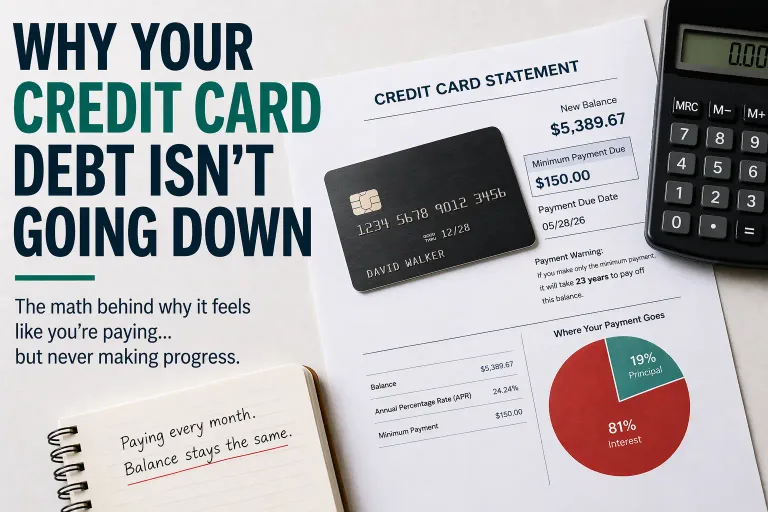
- Why a credit card balance barely drops even when every payment is on time — interest is charged first, and minimum payments are built to keep the account current, not to clear the debt.
- Who this hits hardest: the responsible payer who never misses a payment, watches the balance hold for months, and slowly stops checking — which is when the debt runs longest.
- What the math shows: about 19 years and $7,300 in interest on $5,000 at 20% APR paying minimums, versus under 3 years at a fixed $200 a month — and the three moves that change it.
Your balance barely drops because interest is charged on it before your payment reduces it. At 20% APR, a $5,000 balance generates about $83 in interest a month, so a $100 payment knocks only about $17 off the debt. Minimum payments are designed to keep your account current, not to pay it off — and at minimums, that $5,000 takes roughly 19 years to clear.
That’s why paying every month, on time, can still feel like standing still. The account is in good standing, and the number looks almost the same as it did three months ago. It isn’t a discipline failure. It’s the predictable result of how credit card repayment is structured — and of what that structure does to behavior over time.
Why Does Your Credit Card Balance Barely Go Down?
Credit card interest doesn’t arrive once a month. It accrues daily on your average daily balance, so by the time your payment posts, a large share of it is already spoken for. Payments are applied to interest first, and only what’s left reaches the principal — the actual debt.
Here’s what that looks like on a typical balance:
- Balance: $5,000
- APR: 20% (about 1.67% a month)
- Interest charge: about $83
- Payment: $100
- Applied to principal: about $17
Because interest is recalculated on the remaining balance each cycle, next month’s charge is nearly identical. The meter keeps running at almost the same rate, and the higher your APR, the more of every payment it consumes. Many cards now carry APRs above 20%, according to Federal Reserve consumer credit data — which also puts revolving consumer credit, mostly credit card balances, at about $1.35 trillion.
How Do Issuers Calculate Your Minimum Payment?
A minimum payment is the smallest amount that keeps your account in good standing. It prevents late fees and delinquency reporting. Issuers typically calculate it one of a few ways:
- A flat dollar amount (often $25–$35)
- A percentage of your balance, usually 1–3%
- Interest and fees plus a small slice of principal (commonly 1% of the balance)
- Whichever of these is greater
Most of these formulas shrink as your balance falls. Owe $5,000 and the minimum might be $133; pay it down and the minimum drops with it. That feels like progress. It isn’t — a lower minimum means even less principal is required each month, so the timeline stretches further.
Minimums exist to reduce default risk for the lender. As long as you pay something, the account stays open, the balance keeps generating interest, and the issuer avoids a charge-off.
How Long Can Minimum Payments Keep You in Debt?
Here’s the same $5,000 balance at 20% APR, using a common minimum payment formula (interest plus 1% of the balance, with a $25 floor):
| Minimum Payments Only | Fixed $200/Month | |
|---|---|---|
| First payment | ~$133 (shrinks as the balance falls) | $200 |
| Time to pay off | about 18 years, 10 months | about 2 years, 9 months |
| Total interest paid | about $7,300 | about $1,500 |
| What’s happening | Most of each payment covers interest; the shrinking minimum slows progress further | Extra dollars hit principal; less principal means less interest next cycle |
The same balance. The same person. About $67 more a month at the start — and 16 fewer years.
Federal rules require every card statement to include a minimum payment warning showing how long payoff takes and what it costs if you pay only the minimum. Most people scroll past it.
To see your own version of this table, use the credit card minimum payment calculator — it compares minimum payments against any fixed amount you choose. The calculator below shows what your current payment produces.
What Is Your Balance Actually Costing You?
Enter your current balance, APR, and what you’ve been paying each month.
Credit Card Payoff Calculator
⚠ Estimates use a fixed monthly payment model. Actual timelines vary based on minimum payment recalculations and card terms.
That payoff timeline is what the system produces by default if nothing changes. Most people have never seen it written down — and that number is also where the behavioral problem begins.
Why Do People Get Stuck Even When They Pay On Time?
Seeing 12 years, 17 years, or $7,000 in interest on a $5,000 debt creates a window — a moment where the problem is concrete enough to act on. For most people, that window closes. Not because they don’t care, but because the system gives them no useful feedback for what to do next. Here’s what happens instead:
Pay → see almost no visible progress → quiet frustration → start avoiding statements → pay the minimum and close the app → balance holds or drifts up → loop repeats
Each cycle, the engagement that’s actually required to break out fades a little more. The payments continue — but the tracking, the calculating, the deciding disappears. That’s exactly when balances tend to creep back up, and when the debt mechanics run most efficiently.
When effort produces no visible result, people disengage. That’s not irresponsibility. It’s a predictable response to a feedback system that was never designed to show you accurate progress.
(If a payment slips in that window, here’s what the 30-day timeline looks like — and what to do before it hits your credit report. If the pressure builds to the point where stopping payments entirely starts to feel like a way out, the full consequence sequence — and what’s available before it reaches that point — is covered here.)
How Do You Know If You’re Already Stuck in the Minimum Payment Cycle?
Start with one number: if the interest charge on your last statement was more than half your payment, the cycle is already running on your account.
Other signals:
- The balance barely changes month to month despite consistent payments
- Your credit utilization stays above 30% month after month
- The debt has been on the card for over a year with no meaningful reduction
- You’re using one card for expenses while carrying a balance on another
- The balance has started to feel permanent rather than temporary
Why Are Minimum Payments Designed This Way?
Issuers are in the business of lending money and collecting interest. A cardholder who carries a $5,000 balance for five years generates significantly more revenue than one who pays it off in six months. Shrinking minimums and interest-first allocation naturally produce long repayment timelines — and long timelines mean long-running interest income.
What makes the design effective isn’t just the math — it’s the cover it provides. The account is current. Nothing is technically wrong. There’s no urgent signal, and the balance feels temporary even after it’s been there for a year.
The cost also spreads beyond the card. A balance that barely moves keeps your credit utilization high — and amounts owed make up 30% of a FICO Score — which suppresses your credit score and raises the rate you’re offered on your next car loan, personal loan, or mortgage:
High balance → high interest → small principal reduction → high utilization → lower score → higher borrowing costs → debt persists
And because minimum payments leave no room for a cash buffer, the next car repair or medical bill goes back on the card. Building even a $500 starter emergency fund while paying down debt is what stops each emergency from reloading the balance.
This isn’t a conspiracy. It’s a business model. Understanding it doesn’t require outrage — just clarity about what changes the outcome.
What Actually Changes the Outcome?
Breaking the cycle takes one of three changes — not eventually, but this month.
1. Pay More Than the Minimum
The simplest lever. When you pay above the minimum, the surplus goes almost entirely to principal. Less principal means less interest next cycle, which means more of your next payment reaches principal. The effect compounds faster than most people expect.
On a $5,000 balance at 20% APR, a fixed $200 a month clears the debt in about 2 years 9 months — compared with about 19 years on minimums. Even an extra $50 a month changes the math meaningfully.
It’s not about dramatic sacrifice. It’s about taking the payment pace out of the issuer’s hands. If you’re not sure where the extra comes from, start with the wants category — in a 50/30/20 budget, anything above the minimum belongs in the 20% savings and debt paydown bucket. If a budget isn’t in place yet, building one from scratch shows where that room is — or makes clear that the gap is structural before you look for dollars that aren’t there.
With more than one card, the next question is which to attack first — the debt snowball vs. avalanche comparison shows how to order them.
2. Reduce the Interest Rate
If the rate comes down, more of every payment reaches principal without you paying more. On a $5,000 balance, the monthly interest charge is about $100 at 24% APR and about $58 at 14%.
Call your issuer and ask for a reduction — it costs nothing, especially with a clean payment history, and issuers often prefer a small rate adjustment to losing the account to a balance transfer.
Your rate is also tied to your credit profile. A stronger credit score can significantly lower the rates you’re offered, and if you want to build that profile without going back into revolving debt, there are credit-building tools that don’t require carrying a balance.
3. Restructure the Debt Entirely
For balances where the rate makes real progress nearly impossible, restructuring is often the turning point. Balance transfer cards (0% promotional APR for 12–21 months) and debt consolidation loans (fixed-rate installment loans at lower rates than revolving credit) both turn an open-ended balance into a defined payoff plan.
Debt consolidation vs. balance transfer compares the real payoff numbers for both. For the personal loan route specifically — origination fees, the APR comparison to run first, and why paid-off cards are the most common failure point — this guide covers it end to end. If past debt has already caused friction with lenders, understanding why loan applications get rejected is worth reading before you apply.
Restructuring also removes revolving debt from your utilization calculation, which can lift your score and lower the rate on future borrowing.
Which Fix Fits Your Balance?
You’ve paid minimums for 6+ months with no visible progress → The cycle is already running. Pick one of the three moves above and act on it this month.
Your balance is $5,000 or below → A 0% intro APR balance transfer is likely the fastest, cheapest path. The 3–5% fee is typically less than one or two months of interest. Compare balance transfer vs. consolidation loan options.
Your balance is $5,000–$15,000 → Either raise your payment to at least double the minimum, or consolidate into a personal loan at a lower APR — especially if your card APR is above 20%. See whether the APR math works in your favor.
You’re carrying balances on several cards → Choose an order with the debt snowball or avalanche method, and consider whether one consolidation loan would simplify things.
You can’t pay more than the minimum right now → Ask your issuer about hardship programs, and if your income is fully committed before the month starts, follow the six-step plan for getting out of debt when you’re broke.
Frequently Asked Questions
Why does my credit card balance barely go down even though I pay every month?
Interest is charged on your balance before your payment reduces it. At 20% APR, a $5,000 balance generates about $83 in interest every month. If you pay $100, only about $17 actually reduces the debt — the rest goes to interest.
How long will it take to pay off $5,000 in credit card debt on minimum payments?
At 20% APR, with a common minimum formula (interest plus 1% of the balance, $25 floor), it takes roughly 19 years and about $7,300 in interest — more than the original balance. Your statement is legally required to show an estimate like this in its minimum payment warning.
Why does my minimum payment keep getting smaller — isn't that a good sign?
No. Most issuers calculate the minimum as a percentage of your balance, so it shrinks as the balance falls. A lower minimum means less goes toward principal each month, which stretches the payoff timeline further.
Why is the minimum payment structure designed this way?
Minimum payments exist to keep accounts current and reduce default risk for the lender, not to pay debt off quickly. A cardholder who carries a $5,000 balance for years generates far more interest revenue than one who pays it off in months, so long repayment timelines are what the structure produces.
How much should I pay to actually make progress?
Pay a fixed amount well above the minimum. On a $5,000 balance at 20% APR, a fixed $200 a month clears the debt in about 2 years 9 months with roughly $1,500 in interest, versus about 19 years on minimums. A simple test: if the interest charge on your statement is more than half your payment, your payment isn't working.
Does paying only the minimum hurt my credit score?
Not directly — on-time minimum payments keep your payment history clean. But a balance that barely moves keeps your credit utilization high, which suppresses your score and raises the rate you're offered the next time you borrow.
Will calling my credit card company to ask for a lower rate actually work?
It's worth trying — it costs nothing to ask, especially with a clean payment history. Issuers often prefer adjusting a rate slightly over losing the account to a balance transfer. Even a few points matters: at 14% APR, the monthly interest on $5,000 drops from about $100 (at 24%) to about $58.
What if I can't afford to pay more than the minimum right now?
Call your issuer and ask for its hardship program or a rate reduction — these programs usually aren't advertised. A balance transfer or a lower-rate consolidation loan can also make the same payment go further. If your income is fully committed before the month starts, see the six-step plan for getting out of debt when you're broke.
Should I use a balance transfer or a debt consolidation loan?
It depends on your balance. At $5,000 or below, a 0% intro APR balance transfer is often the fastest, cheapest path — the 3-5% transfer fee is usually less than one month of interest. Over $10,000 or spread across several cards, a consolidation loan turns revolving debt into a fixed-rate loan with a set payoff date.
How does a high credit card balance affect my ability to borrow in the future?
An elevated balance keeps your credit utilization high, which suppresses your credit score and raises the rate you'd be offered the next time you need to borrow. Restructuring the debt — through a balance transfer or consolidation loan — removes revolving debt from your utilization calculation, which can lift your score and lower future borrowing costs.
This article is for informational purposes only and does not constitute financial, legal, or tax advice. Payoff estimates assume a fixed APR, no new purchases, and the minimum payment formula described above; your issuer’s formula and terms may differ. Consult a qualified financial professional before making financial decisions.