
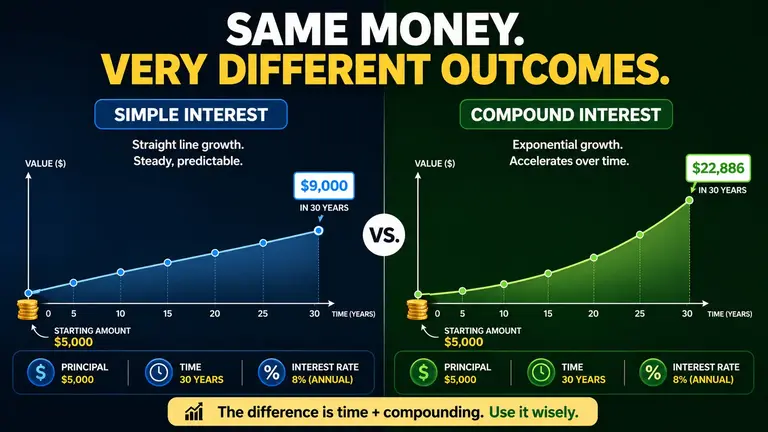
- What simple and compound interest actually are — and why one grows in a straight line while the other accelerates every year you leave it alone.
- Who pays the most for the difference — and why credit card holders, whose interest compounds daily, feel it far more than mortgage or personal loan borrowers.
- What the gap looks like in dollars on a $5,000 balance — and how to use the simulator to see the exact difference for your own rate and time frame.
Simple interest is interest charged only on the original amount you borrowed or invested (the principal), so it grows by the same dollar amount every year. Compound interest is charged on the principal plus any interest that has already built up — the SEC’s Investor.gov defines it as “interest paid on principal and on accumulated interest” — so the amount grows faster every period.
On $5,000 at 8% for 30 years, simple interest adds $12,000. Compounded once a year, the same rate adds about $45,300. That gap is what this article is about: which of your accounts uses which type, and what it costs or earns you.
| Feature | Simple Interest | Compound Interest |
|---|---|---|
| How it’s calculated | On original principal only | On principal + accumulated interest |
| Formula | Principal × rate × years | Principal × (1 + rate ÷ periods)^(periods × years) |
| Growth type | Linear | Exponential |
| Cost (for debt) | Lower and predictable | Higher over time |
| Who it favors | Borrowers | Investors and savers |
| Common examples | Personal loans, federal student loans, auto loans | Credit cards, savings accounts, investments |
Try it yourself: enter any amount, rate and time period below and watch the two lines pull apart. The credit card preset uses a 24% APR compounded daily; the investment preset uses 8% compounded yearly.
Interactive Calculator
Simple vs. Compound Interest Simulator
Adjust the numbers to see how simple and compound interest diverge over time. The gap is the story.
Simple Interest
—
Compound Interest
—
Difference
—
How Can You Tell Which Type of Interest You’re Dealing With?
If interest is only ever calculated on your original balance, you’re dealing with simple interest. Your total cost is fixed from day one.
If your balance keeps rising even when you make payments, or your investment seems to accelerate over time, that’s compound interest.
In the real world:
- Credit cards almost always compound. The CFPB explains that issuers usually turn your APR into a daily periodic rate by dividing it by 360 or 365, and because each day’s interest is added to the next day’s balance, “interest is compounding on a daily basis.”
- Most personal and auto loans use simple or amortized interest, where payments are scheduled over time but interest is never added to the principal and charged again.
- Savings accounts and investment accounts typically compound, which works in your favor.
When you’re reviewing a loan offer or credit card agreement, look for terms like “daily periodic rate,” “daily compounding,” or “average daily balance.” Those phrases tell you compound interest is involved.
Quick test:
- If your balance grows even when you’re not making new purchases → it’s compound interest
- If your total repayment amount is fixed from the start → it’s simple interest
- If interest is calculated daily or monthly on a changing balance → it’s compound
Simple vs. Compound Interest on the Same $5,000
Here’s the same $5,000 in three situations.
Example 1: $5,000 on a Credit Card (Compound, Working Against You)
Card rates make this the costliest case. In the Federal Reserve’s G.19 consumer credit release, the average rate on card accounts that were charged interest was 22.15% in the second quarter of 2026. At 24% APR, paying only a typical minimum (1% of the balance plus that month’s interest, with a $25 floor) takes about 19½ years and close to $8,900 in interest. Why minimum payments stretch out that long is covered in detail in why your credit card debt isn’t going down.
The same compounding balance also keeps your credit utilization high, which can raise the rate you’re offered on your next loan. See how utilization affects your actual loan costs →
Example 2: $5,000 Simple Interest Loan
Now take the same $5,000 borrowed as a personal loan at a fixed simple interest rate of 10% over 3 years.
- Monthly payment: approximately $161
- Total interest paid: roughly $800
- Total repayment: about $5,800
The cost is predictable. It doesn’t snowball. You know exactly what you owe from day one.
Example 3: $5,000 Invested (Compound Interest Working For You)
Now flip it. You invest $5,000 in a low-cost index fund averaging 8% annual returns, compounded annually.
| Year | Balance |
|---|---|
| 5 | ~$7,347 |
| 10 | ~$10,795 |
| 20 | ~$23,305 |
| 30 | ~$50,313 |
You didn’t add another dollar. Compound interest did the work. You can run your own numbers, including monthly contributions, in the SEC’s compound interest calculator on Investor.gov. It’s also why it’s worth knowing when investing should come before paying off debt.
Key takeaway: The same interest system that grows your investments can also double your debt — depending on which side you’re on.
Is Compound Interest Better Than Simple Interest?
It depends on which side of it you’re on.
For borrowers: Simple interest is better. Your cost is fixed and doesn’t accelerate. You know exactly what you owe and when you’ll be done. If you’re carrying high-interest card debt, every month the balance stays is another month of interest on interest — paying it down faster or moving it to a lower fixed rate cuts the compounding directly. Building a monthly budget is where that interest cost becomes a real number next to your take-home pay.
For investors and savers: Compound interest is better. Each period’s gains compound on top of the last, so returns accelerate the longer you stay invested. It doesn’t require perfect picks or market timing — just time.
The short version: borrow simple, invest compound.
What Is the Rule of 72 (And Why It Matters)?
The Rule of 72 is a commonly used shortcut for estimating how long it takes compound interest to double your money.
The formula: 72 ÷ your interest rate = approximate years to double
| Interest Rate | Years to Double |
|---|---|
| 4% | 18 years |
| 6% | 12 years |
| 8% | 9 years |
| 10% | 7.2 years |
| 12% | 6 years |
| 24% (credit card APR) | 3 years |
It also works in reverse for debt. At 24% APR, a credit card balance could theoretically double in about 3 years if left unpaid — which explains how quickly balances spiral.
Which Accounts Use Simple Interest and Which Compound?
Here’s where each type shows up in practice.
Mortgages
Mortgages in the U.S. typically use amortized interest, which is structured similarly to simple interest. Each monthly payment covers both principal and interest, and the interest portion is calculated on the remaining principal balance — not on accumulated interest. Early payments go mostly to interest and later payments mostly to principal, but at no point is interest added to your principal and charged again. That’s why mortgage balances go down when you make consistent payments.
Credit Cards
Credit cards compound daily: the daily periodic rate is applied to your full balance every day, including interest already added. Carrying a balance past the grace period is one of the most expensive things you can do with debt — even a few months lets compounding build momentum.
Savings Accounts and CDs
Standard savings accounts and certificates of deposit (CDs) compound — typically daily or monthly, credited monthly. A high-yield savings account at 4.5% APY means earned interest starts earning interest right away. APY (Annual Percentage Yield) already accounts for compounding, while APR does not, so when comparing savings products, compare APY to APY.
Investment Accounts
Index funds and brokerage accounts don’t use a set interest rate — returns vary with the market. But the compounding effect still applies: dividends are reinvested, gains generate further gains, and the portfolio grows over time.
Student Loans
Federal student loans typically use simple interest, accrued daily on the outstanding principal. Interest doesn’t capitalize (get added to principal) unless you exit a grace period, leave deferment or forbearance, or enter certain repayment plan transitions. Private student loans vary — some compound, some don’t. Always check before signing.
The Pattern
| Product | Interest Type | Works For/Against You |
|---|---|---|
| Credit cards | Compound (daily) | Against |
| Mortgages | Amortized (simple-like) | Predictable |
| Savings accounts | Compound (daily/monthly) | For |
| Personal loans | Simple | Predictable |
| Student loans (federal) | Simple | Predictable |
| Investment accounts | Compound returns | For |
Before you borrow, ask how interest is calculated. Before you invest, look for accounts where compounding works in your favor. Most people don’t lose money because they don’t understand interest — they lose it because they don’t notice when it’s working against them.
Frequently Asked Questions
What's the actual difference between simple and compound interest?
Simple interest is calculated only on the original principal, so it grows in a straight line. Compound interest is calculated on the principal plus any interest that's already accumulated, so interest earns interest and it grows exponentially instead of linearly. For borrowers that's the difference between a manageable loan and debt that never seems to shrink; for investors it's the difference between steady growth and wealth that accelerates on its own.
How can I tell if my loan or credit card uses simple or compound interest?
If interest is only ever calculated on your original balance, it's simple interest and your total cost is fixed from day one. If your balance keeps rising even when you make payments, or your investment seems to accelerate over time, that's compound interest. Look for phrases like daily periodic rate, daily compounding, or average daily balance on a loan offer or card agreement — those signal compound interest is involved.
How much more does compound interest cost me on a credit card compared to simple interest?
On a $5,000 balance at 24% APR with only minimum payments (1% of the balance plus that month's interest, with a $25 floor), it takes about 19½ years to pay off, with close to $8,900 in interest and about $13,900 in total repayment — well over double what was borrowed. The same $5,000 as a simple-interest personal loan at 10% over 3 years costs only about $800 in interest, for a total repayment near $5,800.
What is the Rule of 72 and how do I use it?
The Rule of 72 is a shortcut for estimating how long it takes compound interest to double your money: divide 72 by the interest rate. At 8% that's about 9 years; at 24% APR — a typical credit card rate — an unpaid balance could theoretically double in about 3 years, which explains how quickly balances spiral.
Do mortgages use compound interest like credit cards do?
No. Mortgages in the U.S. typically use amortized interest, which is structured similarly to simple interest — each payment's interest portion is calculated on the remaining principal balance, not on accumulated interest. Credit cards, by contrast, compound daily by applying a daily periodic rate (APR divided by 365) to the full balance, including previously accumulated interest, every single day.
Is compound interest ever a bad thing?
It depends entirely on which side of it you're on. For borrowers, simple interest is better because the cost is fixed and doesn't accelerate. For investors and savers, compound interest is better because gains compound on top of gains, so returns accelerate the longer you stay invested. The short version: borrow simple, invest compound.
Do student loans use simple or compound interest?
Federal student loans typically use simple interest, accrued daily on the outstanding principal, and that interest doesn't capitalize — get added to principal — unless you exit a grace period, leave deferment or forbearance, or enter certain repayment plan transitions. Private student loans vary, so it's worth checking before signing.
Why does compound interest help me when investing but hurt me when I'm in debt?
It's the same mechanism working in opposite directions. When you invest, dividends and gains reinvest and generate further gains, so a one-time $5,000 investment at 8% annual returns can grow to over $50,000 after 30 years with zero additional contributions. When you carry debt, that same mechanism applies to what you owe — interest is charged on interest already accumulated, which is why a $5,000 credit card balance paid at the minimum can cost about $13,900 in total repayment.
Sources: SEC Investor.gov — compound interest definition and compound interest calculator; Consumer Financial Protection Bureau (CFPB) — how credit card daily periodic rates and daily compounding work; Federal Reserve G.19 — average interest rate on credit card accounts assessed interest.