
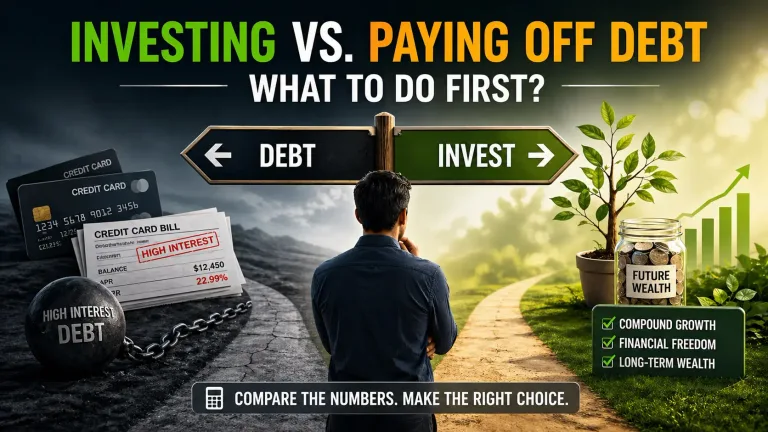
- Whether to invest or pay off debt first comes down to one comparison — your debt's interest rate against a realistic investment return — and the 6% rule settles most close calls.
- People carrying credit card debt at 18–30% APR lose the most by guessing wrong: no mainstream investment reliably outpaces that cost, so investing alongside it usually loses ground.
- The calculator compares paying debt first, investing from day one, and a hybrid split with your own numbers — and shows how many dollars ahead the best path leaves you.
Compare your debt’s interest rate to what your investments are likely to earn. Paying off debt gives you a guaranteed return equal to its interest rate. Investing gives you an expected return — historically around 6–10% a year for a broad stock index — that isn’t guaranteed in any given year. If the debt costs more than the investment is likely to earn, pay the debt first. If it costs less, invest.
The short version: above 8% interest, pay the debt down first. Below 5%, lean toward investing. Between 5% and 8%, the 6% rule breaks the tie — and a hybrid split is reasonable on either side of it.
Which Is Right For You?
Find your debt's interest rate on your latest statement, then:
Is it above 8% (most credit cards, many personal loans)?
→ Pay off debt first. The guaranteed return beats likely market returns.
Is it below 5% (e.g., a low fixed-rate mortgage or subsidized student loan)?
→ Lean toward investing. Long-term market returns have historically outpaced low-rate debt.
Is it between 5% and 8%?
→ Use the 6% rule below as the tie-breaker, or split your extra cash between both. Revisit every 6 months as your balance drops.
In every case, capture any employer 401(k) match first — it beats every debt rate.
How Do You Decide Whether to Invest or Pay Off Debt First?
Every dollar you put toward debt earns a guaranteed return equal to the interest rate. Pay off a card charging 20% APR, and that’s a risk-free 20% return — no market movement required. Every dollar you invest goes into markets that move up and down, while debt interest keeps running regardless. So the comparison is a guaranteed return on one side against a probable one on the other.
| Your Debt’s Interest Rate | Recommendation | Reasoning |
|---|---|---|
| Above 8% (e.g., credit cards, payday loans, most personal loans) | Pay debt first | The guaranteed return beats likely market returns |
| 5–8% (e.g., some personal and student loans) | Close call — use the 6% rule or a hybrid split | Both approaches have merit; personal factors decide |
| Below 5% (e.g., low-rate mortgages, subsidized student loans) | Lean toward investing | Long-term market returns likely outpace the interest cost |
Generic advice tends to pick a side — “pay off all debt before investing” or “start investing as early as possible.” Both ignore the actual numbers. Someone paying 4.5% on a fixed mortgage is in a very different position from someone carrying $12,000 at 22% APR on a credit card, and one prescription for both is how people make expensive mistakes.
What Is the 6% Rule and Why Is It the Fastest Filter for This Decision?
Financial planners use a rough threshold for this decision: if your debt’s interest rate is above 6%, prioritize paying it off before investing beyond an employer match.
Here’s why 6% is the line. A diversified long-term portfolio — something like a total market index fund — has historically returned roughly 6–8% a year over multi-decade periods once inflation is accounted for. The S&P 500 has averaged around 10% a year before inflation since 1928, closer to 7% after it, and about 6.3% after inflation over the 30 years through 2024. Planners use 6% as a conservative baseline: debt that costs more than that is likely costing you more than investing would earn.
Put it in concrete terms. Say you have $5,000 to allocate and you’re carrying debt at 10%:
- Paying off $5,000 of debt at 10%: saves you $500 in interest this year, guaranteed
- Investing $5,000 at an expected 7% return: earns roughly $350 this year, not guaranteed
The debt payoff wins — and its return is certain, because you’re eliminating a certain cost.
Now flip it. Same $5,000, but your debt is a federal student loan at 3.5%:
- Paying off $5,000 of 3.5% debt: saves you $175 this year
- Investing $5,000 at an expected 7% return: earns roughly $350 this year
Now investing wins — especially once you add the tax advantages of a Roth IRA or 401(k).
The 6% line isn’t a law. It’s a sorting tool. Use it to categorize your debt, then run your actual numbers in the calculator below.
Quick Decision Shortcut:
- Debt above 6% → Prioritize payoff
- Debt below 6% → Prioritize investing (after the basics)
- Close to the line, or juggling several debts → Run the numbers below
How Do Your Own Numbers Compare? Debt vs. Investing Calculator
You need three numbers: your debt balance and interest rate (from your latest statement), the monthly amount you can put toward debt and investing combined, and an expected investment return — 7% is a common long-term assumption for a broad index fund. The calculator runs three paths side by side: paying debt first, investing from day one while paying only your current payment, and a hybrid split you control with the slider.
Decision Engine
Debt vs. Investing Calculator
When Is Paying Off Debt the Right Financial Call Over Investing?
High-interest debt (above 8–10%). Credit cards, payday loans and double-digit personal loans are the primary target. Credit card APRs typically range from 18% to 30%, averaging around 21–22%, according to Federal Reserve consumer credit data. Most cards also compound interest daily, so at 22% APR the effective annual rate creeps above 24%. No mainstream investment reliably beats that on a risk-adjusted basis — which is why investing while carrying it usually means losing ground in net terms, even if your brokerage account shows growth.
Real example: $10,000 in credit card debt at 20% APR, minimum payments only. Timeline to payoff: 25–30+ years. Total paid: $25,000–$28,000 or more — that’s $15,000–$18,000 in interest to eliminate a $10,000 debt.
Put your own balance and APR into the credit card minimum payment calculator to see what that timeline looks like for you. This is compound interest working against you, and you can’t outrun it by investing small amounts on the side.
Cash flow pressure. If minimum payments consume a large share of your income, consistent investing isn’t realistic anyway. Minimum payments are structured to keep accounts current, not eliminate debt, which is why they can absorb income for years without meaningfully reducing what you owe. Reducing balances frees up the margin that lets you invest later.
Debt-driven anxiety. A 2019 study in the Proceedings of the National Academy of Sciences found that relieving debt improved psychological functioning and changed decision-making — evidence that carrying debt weighs on how well people make decisions. Sometimes clearing the weight is worth a small mathematical trade-off.
When Does Investing Beat Paying Off Debt?
Low-interest debt (below 5%). A 3% mortgage or a 4.5% subsidized student loan costs less each year than a long-term diversified portfolio is likely to earn over 20–30 years. Accelerating payoff here gives up compound growth at the point where time matters most.
Employer 401(k) match. If your employer matches contributions up to a certain percentage, that match is an immediate 50–100% return on your money — higher than any debt’s interest rate. Leaving it uncaptured to pay off a loan faster is almost always a poor trade.
A long time horizon. Each year you delay investing isn’t just one year of lost returns — it’s decades of compounding on those returns. Over 10, 20 or 30 years, time in the market becomes more valuable than the small interest savings on low-rate debt.
Can You Invest While Paying Off Debt?
Yes — and for many people in the 5–8% range, a split makes both financial and psychological sense. You direct most of your extra cash toward debt (roughly 60/40 or 70/30 favoring debt) while still investing something, so neither goal stalls. Use the hybrid slider in the calculator to see how a split compares with going all-in either way.
When the hybrid works best: your debt’s rate is between 5% and 8%, your income is stable and predictable, you already have a basic emergency fund, and you have a long investment horizon (10+ years). In that situation, the compound growth you’d miss by pausing investing can outweigh the relatively small interest savings.
When it backfires: above 10%, splitting your dollars is almost always a losing strategy — high-interest debt compounds faster than most investments grow, so you make slow progress on both fronts. Irregular income also undermines it: a lean month while carrying both investment risk and debt payments creates real financial fragility.
Should You Invest or Pay Off Your Mortgage Early?
Mortgages sit in a different category from consumer debt: the rate is usually much lower, and the loan is attached to an asset that tends to appreciate. A mortgage at 3.5%–7.5% — the range issued over the past decade, from the lows of 2020–2021 to the elevated rates of 2022–2024 — doesn’t carry the urgency of credit card debt.
If your mortgage rate is below 6%, the long-term case for investing over extra principal payments is historically strong. Assuming a 7% average annual return, every extra dollar sent to a 4% mortgage gives up a 3-point gap that compounds over 20 or 30 years.
There are legitimate reasons to prioritize payoff anyway. If you’re approaching retirement and want to remove housing cost risk, a paid-off home provides stability a brokerage account doesn’t. If your rate is above 6.5%–7%, the math case for early payoff becomes much stronger. And for some people, owning their home outright is worth the trade-off.
Should You Keep Contributing to Retirement While Paying Off Debt?
Always capture the full employer match first. Beyond the match, it depends on the debt’s cost. If you’re carrying 20% APR credit card debt, pausing 401(k) contributions above the match to eliminate that debt quickly is defensible. If your debt is moderate-rate and manageable, maintaining Roth IRA or 401(k) contributions keeps your retirement trajectory intact.
Contribution limits make consistency matter: the IRS caps 2026 IRA contributions at $7,500 for those under 50, and a year you skip can’t be made up later.
Can Lowering Your Interest Rate Change the Answer?
Yes — often more than the invest-or-pay-off choice itself. If you’re carrying three credit cards averaging 21% APR and qualify for a personal loan at 11%, you’ve cut your cost of debt nearly in half, and that may move you from “pay debt first” toward the hybrid zone. A 0% intro APR balance transfer card does the same thing temporarily, as long as the balance is cleared before the promotional period ends.
Neither works without a plan to keep the cards from filling back up. For the full cost comparison, see using a personal loan to pay off credit card debt and debt consolidation vs. balance transfer.
Do You Need an Emergency Fund First?
Yes. Without a buffer, the first car repair or medical bill goes straight onto a credit card at your highest rate, and the debt cycle restarts. The Federal Reserve’s household well-being survey consistently finds that many adults couldn’t cover an unexpected expense with cash. Start with $1,000–$2,000, then build toward 3 to 6 months of essential expenses — how to build an emergency fund covers how to set the target and build it while carrying debt.
What’s the Step-by-Step Framework for Deciding Where Your Next Dollar Should Go?
“The right answer isn’t invest or pay off debt. It’s: which one gives you the best return on your next dollar?”
Step 1 — Secure a basic emergency fund ($1,000–$2,000 minimum). This is your financial floor. Without it, you’re one surprise away from derailing everything else.
Step 2 — Capture any employer 401(k) match — always. Contribute at least enough to get the full match. It’s an immediate, guaranteed return.
Step 3 — Sort your debt with the rate bands and the 6% rule. Above 8%: focus on debt. Below 5%: lean into investing. In between: the 6% rule or a hybrid split. The amount you have to direct comes from your monthly surplus — a seven-step monthly budget calculates that number from your real take-home pay.
Step 4 — If your rate is high, try to lower it first. Consolidation, a balance transfer or refinancing can change the whole equation.
Step 5 — Run your numbers, pick a path, and revisit every 6 months. As balances drop and your situation changes, the right answer can shift.
What Is the Mistake That Sets People Back Years?
Going all-in on one side. Every spare dollar into low-rate debt with no investing leaves you debt-free with no compounding base to build on — and you can’t buy back the years. Investing aggressively while ignoring high-interest debt means earning 7–8% on one side while paying 20%+ on the other, a guaranteed net loss every month.
For most people, the answer is to eliminate high-interest debt aggressively, capture employer matches unconditionally, and keep investing in small amounts so the compounding clock keeps running.
What’s the Bottom Line on Investing vs. Paying Off Debt?
Treat this as a math question, not a values question. High interest rate: reduce the cost of the debt first — that is your best investment right now. Low interest rate: build the long-term position and let compounding do the work. In between: use the 6% rule or split, stay consistent, and revisit.
If you have no significant debt, the question changes from “debt vs. investing” to how much to keep liquid versus how much to invest — start with the emergency fund target, then invest the rest.
Any consistent direction beats waiting for perfect conditions. Get your three numbers, run the calculator above, and pick a path.
Frequently Asked Questions
What's the simple rule for deciding whether to invest or pay off debt first?
Compare your debt's interest rate to what investments are likely to return. Above 8%, paying the debt down is almost always the better move. Below 5%, lean toward investing. Between 5% and 8%, use the 6% rule as the tie-breaker: above 6% lean toward the debt, below 6% lean toward investing, and a hybrid split is reasonable either way.
What is the 6% rule for deciding between paying off debt and investing?
If your debt's interest rate is above 6%, prioritize paying it off before investing beyond an employer match. Financial planners commonly use 6% as a conservative long-term return baseline for a diversified portfolio, so debt that costs more than that is likely costing you more than investing would earn. It's a sorting tool, not a law — use it to categorize your debt, then run the actual numbers.
How much money do I actually save by paying off debt versus investing?
It depends on the rate gap. On $5,000 of debt at 10%, paying it off saves $500 in interest this year, guaranteed, versus roughly $350 from investing the same amount at an expected 7% return, which isn't guaranteed. On a 3.5% student loan, paying it off saves only $175 a year, while investing at 7% earns roughly double that — so investing wins instead.
Should I invest while carrying high-interest credit card debt?
Generally no. Credit card APRs typically run from 18% to 30%, averaging around 21-22% according to Federal Reserve consumer credit data. No mainstream investment reliably beats that on a risk-adjusted basis, so investing while carrying that debt usually means losing ground in net terms even if your brokerage account shows growth. The exception is an employer 401(k) match, which is worth capturing regardless.
Should I pay off my mortgage early or invest instead?
It depends on your mortgage rate. If it's below 6%, the long-term case for investing over extra principal payments is historically strong, since a 7% average annual investment return would outpace what you'd save on a 4% mortgage. If your rate is above 6.5-7%, the case for early payoff becomes much stronger.
Should I skip my 401(k) match to pay off debt faster?
No. If your employer matches 50% or 100% of your contributions up to a certain percentage, that's an immediate 50-100% return before any market growth — no debt has an interest rate that beats that. Capture the full match first, then apply the rate comparison to everything else.
Do I need an emergency fund before choosing either path?
Yes. Without a cash buffer, the first unexpected expense goes back onto a credit card at your highest interest rate, which restarts the debt cycle. Start with $1,000-$2,000, then build toward the commonly cited 3 to 6 months of essential expenses. See how to build an emergency fund for a step-by-step plan.
What is the hybrid strategy and when does it make sense?
The hybrid strategy means directing most of your extra cash toward debt payoff while still contributing something to investments — for example a 60/40 or 70/30 split favoring debt. It works best when your debt's rate is between 5% and 8%, your income is stable, you already have a basic emergency fund, and you have an investment horizon of 10+ years. Above 10%, splitting your dollars is almost always a losing strategy mathematically.
What's the biggest mistake people make in the debt-versus-investing decision?
Going all-in on one side. Putting every dollar toward low-rate debt with no investing means ending up debt-free with no compounding base — and you can't buy back the lost years. Investing aggressively while ignoring high-interest debt means earning 7-8% on one side while paying 20%+ on the other, a guaranteed net loss every month.
Disclaimer: This article is for educational and informational purposes only. It does not constitute financial, tax, or investment advice. Interest rates, market returns, and personal financial situations vary significantly. Consult a licensed financial advisor before making significant financial decisions. Historical S&P 500 return references are based on long-term average data; past performance does not guarantee future results. Credit card APR data referenced from the Federal Reserve G.19 consumer credit report.