
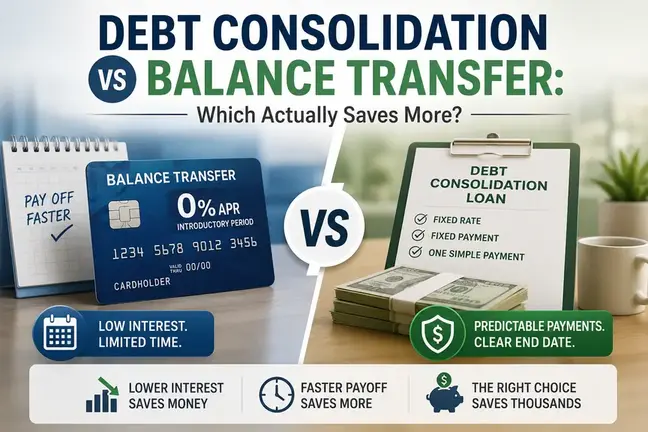
- Why credit card APR silently erodes every payment you make — and how a balance transfer or consolidation loan can change the math significantly.
- Who each option fits: smaller balances cleared fast favor the balance transfer; larger balances needing a longer runway favor the consolidation loan.
- What the repayment numbers actually show at $10K and $20K — and why the cheapest option on paper isn't always the one that saves the most money.
You’ve been making payments for months. Maybe years. And somehow, your credit card balance barely moves.
That’s not a budgeting failure — it’s math. With the average credit card APR at 21.52% on accounts carrying a balance, most of every payment gets eaten by interest before it ever touches your principal. If your payment barely covers what interest adds each month, the balance doesn’t shrink — it stalls. This is why your balance isn’t going down, and the same trap that keeps people stuck on minimum payments forever.
Two solutions tend to surface when people look for a way out: a balance transfer to a 0% APR card, or a debt consolidation loan that combines everything into one fixed monthly payment. Both reduce interest. Both accelerate payoff. The central question is which one actually saves more.
The honest answer depends on your debt amount, repayment speed, credit score, and spending habits going forward. This guide breaks down how each option works, where each one wins, and how to choose the path you’ll actually finish. Specific scenarios. Real dollar figures. A clear decision framework.
| Factor | Balance Transfer | Debt Consolidation Loan |
|---|---|---|
| Best for | Smaller balances | Larger balances |
| Typical timeline | 15–21 months | 3–5 years |
| Credit needed | Good to excellent (670+) | Fair to good (640+) |
| Payment style | Aggressive payoff | Structured, predictable |
| Main risk | Promo APR expiring | Longer repayment term |
| Key advantage | Lowest short-term interest | Fixed payment, fixed end date |
What’s the Difference Between a Balance Transfer and Debt Consolidation?
Both aim to reduce interest. The mechanics are completely different.
What Is a Balance Transfer?
A balance transfer moves existing credit card debt onto a new card offering a 0% introductory APR. During that window, interest stops accruing, so every dollar you pay goes straight to principal.
The catch is the balance transfer fee. Transfer fees typically range from 3% to 5% of the amount transferred, with 5% more common on cards offering the longest 0% periods.
Promotional periods stretch up to 21 months on the most competitive offers, with the average closer to 15 to 18 months. After that, the card reverts to a standard variable APR — usually 17% to 28%. The savings are real, but temporary by design.
What Is a Debt Consolidation Loan?
A debt consolidation loan is a fixed-rate installment loan used to pay off credit cards in one shot. You’re left with one monthly payment, one interest rate, and a defined payoff date — typically 24 to 60 months. If you’re specifically evaluating a personal loan to consolidate credit card debt — including what rate gap makes it worth it, what origination fees do to the numbers, and the behavioral trap that makes it backfire — this guide covers all of it.
The average personal loan rate in early 2026 was 12.27% for borrowers with a 700 FICO score, and the Federal Reserve reported an average of 11.40% on 24-month bank loans. Compared to a 21%+ credit card APR, that’s a substantial gap. Federal credit unions cap rates at 18%, often making them the most affordable option for borrowers who qualify.
How Each Option Actually Saves Money
How Balance Transfers Reduce Interest Costs
When APR drops to 0%, the entire payment becomes principal. On $10,000 at 22%, you’d normally pay roughly $183 a month in interest alone — money that never reduces what you owe. A balance transfer eliminates that, for the length of the promo period.
The risk shows up at the end. Any remaining balance reverts to the card’s go-to APR, often 17% to 28%. If the balance isn’t mostly gone by month 18 or 21, the savings unwind fast.
How Debt Consolidation Loans Lower Total Costs
A consolidation loan replaces revolving, variable, high-interest debt with structured, fixed, lower-interest debt. Your APR drops significantly — often from the low 20s to the low teens — and the loan amortizes on a fixed schedule, forcing progress every month.
This matters because credit card debt compounds against you when you carry a balance — a $5,000 balance at minimum payments can take nearly two decades to clear.
A consolidation loan cuts that to a defined window — usually 3 to 5 years.
The alternative — doing nothing and continuing to service revolving debt at 20%+ — is rarely neutral. Every month without a structured payoff plan is a month where interest compounds, balances barely move despite consistent payments, and the total cost of the debt quietly grows. Both options above are meaningfully better than staying put.
When a Balance Transfer Makes More Sense
For smaller balances with strong cash flow, a balance transfer typically creates the largest savings. Here’s why.
You Have Strong Credit
The best 0% offers are gated. Issuers typically require a FICO score of 670+, with the longest offers requiring 720+. Below 670, approval odds drop sharply, and the card you do get may come with a credit limit smaller than your debt — which defeats the purpose.
You Can Pay Off Debt Quickly
Balance transfers reward speed. A 21-month 0% window only saves money if you can clear the balance before it ends. On $5,000, that’s roughly $240 a month. On $10,000, $480 a month. If your budget can’t support that pace, deferred interest risk grows and the advantage shrinks.
Your Debt Amount Is Relatively Small
Transfer limits cap at whatever the issuer extends — often $5,000 to $15,000 for typical applicants. If your total credit card debt is $25,000, one transfer rarely covers it. Splitting across multiple cards is harder to manage and harder to qualify for. Smaller, focused balances are where balance transfers shine.
When a Debt Consolidation Loan Makes More Sense
For larger balances or longer repayment timelines, consolidation loans are often the more practical choice. Here’s why.
You Need More Time to Repay Debt
Consolidation loans typically run 36 to 60 months. That spreads the payment out when you can’t realistically clear the balance in under two years — and removes the risk of an APR reset at month 18 or 21.
You Have Larger Credit Card Balances
Transfer limits on most cards top out at $15,000 or less, making large balances difficult to move in one step. Personal loans can scale to $50,000 or more for qualified borrowers and come with a fixed payoff schedule — so the balance doesn’t linger indefinitely on a revolving line.
You Want One Predictable Monthly Payment
Juggling four cards with four due dates and four APRs is friction that adds up. A single fixed payment is predictable, automatic, and easier to budget around. Minimum payments, by contrast, drop as the balance shrinks — keeping repayment slow by design, as our guide on why minimum payments don’t work explains. A consolidation loan replaces that structure with a fixed amount and a fixed end date. For a full breakdown of how to run the APR comparison before applying — including the fee math, the credit score impact, and what happens if you keep using the paid-off cards — see the complete personal loan guide here.
See What You'd Actually Qualify For
If high-interest credit card debt is becoming difficult to manage, you can check consolidation loan rates and monthly payments without a hard credit pull — most lenders use a soft inquiry for initial rate quotes, which doesn't affect your credit score. You only take the hard pull hit if you formally apply.
Compare Debt Consolidation Offers →Debt Payoff Calculator
Compare Debt Payoff Options
See how a balance transfer, consolidation loan, or staying on high-interest credit cards changes your repayment timeline and total interest costs.
See What You'd Actually Qualify For
Checking available options won't affect your credit score.
Compare Consolidation Loan OptionsBalance Transfer vs Debt Consolidation for $10,000 in Credit Card Debt
If your balances keep rolling month to month with only minimum payments, the numbers below show exactly what that costs — and what either alternative would save.
Example Scenario: Paying Off $10,000 Aggressively
Option A — Balance Transfer Card
- $10,000 transferred to a card with 0% APR for 21 months
- 3% transfer fee = $300 upfront
- Pay $476/month to clear it in 21 months
- Total cost: $10,300
Option B — Debt Consolidation Loan
- $10,000 personal loan at 12% APR over 36 months
- Monthly payment: roughly $332
- Total cost: about $11,960 (roughly $1,960 in interest)
Option C — Status Quo
- $10,000 on a credit card at 22% APR, paying $300/month
- Time to payoff: roughly 49 months
- Total interest paid: about $4,700
Which Option Usually Works Better at This Debt Level?
If you can handle ~$480/month, the balance transfer wins. If that’s out of reach but $330 is doable, the consolidation loan still saves nearly $3,000 versus carrying the card. The status quo costs nearly $4,700 in interest — making it the worst outcome regardless of which alternative you choose.
The deciding factor isn’t the math — it’s whether your budget can sustain the higher monthly payment all the way through.
Larger balances, however, create a different problem entirely.
Balance Transfer vs Debt Consolidation for $20,000 in Credit Card Debt
Why Larger Balances Change the Equation
At $20,000, the calculus shifts. Clearing it within a 21-month 0% window requires roughly $952/month — a level few households can absorb. And most balance transfer cards won’t extend a $20,000 credit limit to a typical applicant, so you’d have to split the transfer or move only part of the balance.
Why Structured Repayment Often Becomes More Important
At higher debt levels, the challenge often stops being purely mathematical and becomes behavioral. The pressure of needing nearly $1,000 a month to hit a payoff deadline can cause people to abandon the plan entirely — and slip back into minimum-payment mode.
A consolidation loan at $20,000 over 60 months at 12% APR runs about $445/month — sustainable for most working households. You’ll pay more interest over the longer term (roughly $6,700), but you’ll actually complete the payoff.
For larger balances, the question isn’t cheapest possible cost — it’s what’s the plan I can stick to. A finished consolidation beats an abandoned balance transfer every time.
Which Option Is Better for Your Credit Score?
How Balance Transfers Affect Credit Utilization
Your credit utilization ratio — how much of your available credit you’re using — accounts for roughly 30% of your FICO score. Opening a new balance transfer card increases total available credit, which can lower your utilization — a positive signal.
Short-term offsets to expect:
- A hard inquiry can dock your score temporarily
- The new account lowers your average account age
- Maxing out the new card pushes its utilization high, which FICO also notices
As the balance pays down, utilization improves and the initial dip often reverses. Our explainer on credit utilization covers this in detail.
How Debt Consolidation Loans Affect Credit
Paying off revolving credit card debt with an installment loan immediately drops your revolving utilization — often to near zero. Your total debt may not change, but the type does, and FICO treats installment debt more favorably than revolving debt.
You’ll take a hard inquiry hit at application. Credit score changes depend on your overall profile and repayment behavior, but lower revolving utilization can positively affect scores over time.
Risks Most People Don’t Think About
If you’ve been paying consistently without seeing meaningful progress, one of these two options may finally change that trajectory — but only if you go in clear-eyed about what can go wrong.
The promo clock on balance transfers runs whether or not you’re ready. Whatever remains at the end of the 0% window gets hit with the go-to APR immediately. The fix is mechanical: divide your transferred balance by the number of promo months, and pay at least that amount every single month. Don’t rely on making it up later.
Clearing your cards doesn’t solve overspending. Both strategies bring your card balances to zero — and that’s where many people run into trouble. With fresh credit limits available, it’s common to run balances back up. Now you have a loan and new card debt. Neither tool prevents that. The behavioral change has to come with the financial one.
Read the fine print on fees and penalties. Costs beyond the headline APR:
- Balance transfer fees: typically 3% to 5%
- Origination fees on personal loans: 0% to 8%, depending on the lender
- Late payment penalties can trigger penalty APRs up to 29.99%
- Missing a single balance transfer payment can void the 0% promo on some cards — and can trigger a penalty APR on top of that. See what a single late payment actually sets in motion.
The headline rate isn’t always what you end up paying. Read the cardholder agreement or loan disclosure before you sign.
So Which Option Actually Saves More?
A Balance Transfer Usually Saves More If…
- Debt is under $15,000 and payable within 15–21 months
- Credit score is 670 or higher
- Spending is under control and won’t add new balances
- You can absorb the 3%–5% transfer fee upfront
A Debt Consolidation Loan Usually Saves More If…
- Debt is $15,000 or more and payoff will take 3–5 years
- You need one fixed payment and a predictable end date
- Credit is fair to good (640+ often qualifies)
- You need sustainable payments over strict ones
The Best Way to Choose Between Them
Questions to Ask Yourself Before Choosing
- How quickly can you realistically repay this debt? Look at your real budget, not the aspirational one.
- Is your credit score high enough for a strong 0% offer? Below 670, most premium balance transfer cards become hard to get.
- Will you stop adding new balances? If no, neither option works long-term.
- Do you need lower payments or faster payoff? This trade-off defines the right tool.
Why the Lowest Interest Rate Isn’t Always the Best Choice
The cheapest path on paper is meaningless if you can’t sustain it. A 21-month 0% balance transfer looks unbeatable until the monthly payment required is double what you can afford. Miss the deadline, get hit with the go-to APR, and you end up worse off than if you’d taken the loan.
The best option fits your actual cash flow, your real spending behavior, and a timeline you’ll stick to. Sustainability beats theoretical savings every time.
A Realistic Path Out
The right choice between these two options comes down to three things: how much you owe, how fast you can pay it off, and whether your credit qualifies you for the best terms.
For smaller balances you can clear within 21 months, a 0% balance transfer typically wins on pure cost — you pay a 3%–5% fee and nothing else in interest. For larger balances that need a longer runway, a consolidation loan gives you a fixed payment, a fixed rate, and an actual finish line — without the risk of a rate reset mid-payoff.
If you’ve been carrying this debt for a year or more and watching the balance barely move, the math is working against you every month you stay on revolving credit. Both options above break that dynamic. The question is which one fits the repayment pace you can actually sustain.
Checking what rate you’d qualify for costs nothing. Most lenders use a soft credit pull for initial rate quotes — no impact to your score until you formally apply.
For more on the mechanics behind credit card debt, see our guides on why credit card debt isn’t going down and why minimum payments don’t work.