
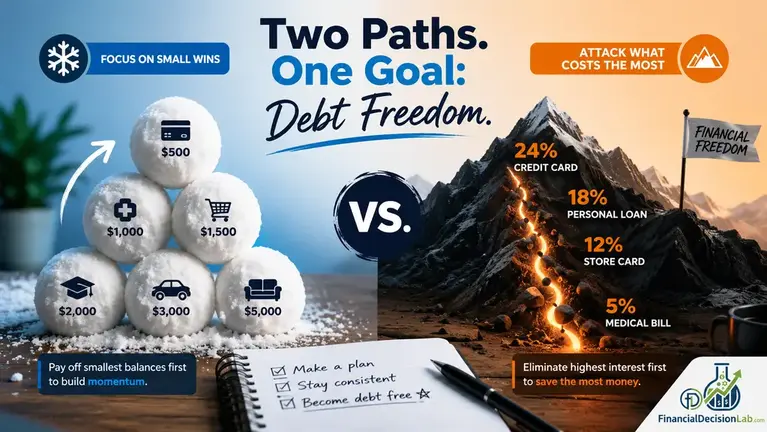
- Which debt payoff method saves more money — the avalanche, by a few hundred dollars on a typical three-debt stack — and why that gap is smaller than most people expect.
- Who should pick the snowball instead — anyone who has started a payoff plan and quit, or who has four or more separate balances — and why an early cleared account matters for them.
- What the numbers look like on a real debt stack, side by side — and a calculator that runs both methods on your own balances so you can see the gap before you commit.
The debt avalanche (highest APR first) always saves more in interest than the debt snowball (smallest balance first). The snowball is the one people are more likely to stick with, because it clears a whole account sooner — and on most debt stacks the dollar difference between them is a few hundred dollars, not thousands.
So the choice comes down to one question: which plan will you still be following a year from now? If you have a balance above 20% APR and you’re confident you’ll stay the course, use the avalanche. If you’ve started and stopped before, use the snowball. Both beat paying minimums by thousands, and the CFPB describes both approaches as valid ways to reduce debt.
Which Payoff Method Fits Your Debts?
Answer three quick questions:
1. Do you have any debt with an APR above 20%? → Yes: Start with the Avalanche. The interest cost of waiting on a 22–26% APR balance is measurable and material. Math wins here.
2. Have you started a debt payoff plan before and abandoned it? → Yes: Start with the Snowball. The momentum from clearing a small balance early is worth more than the interest savings on paper.
3. Are all your balances and rates in a similar range? → Yes: Either method works. The difference in total interest will be minimal. Pick the one you’ll actually execute.
If questions 1 and 2 both get a “yes,” the tiebreaker is the number of debts: more than four separate balances plus a previous failed attempt almost always points to the snowball. You can switch methods later — see the FAQ.
How Each Method Orders Your Debts
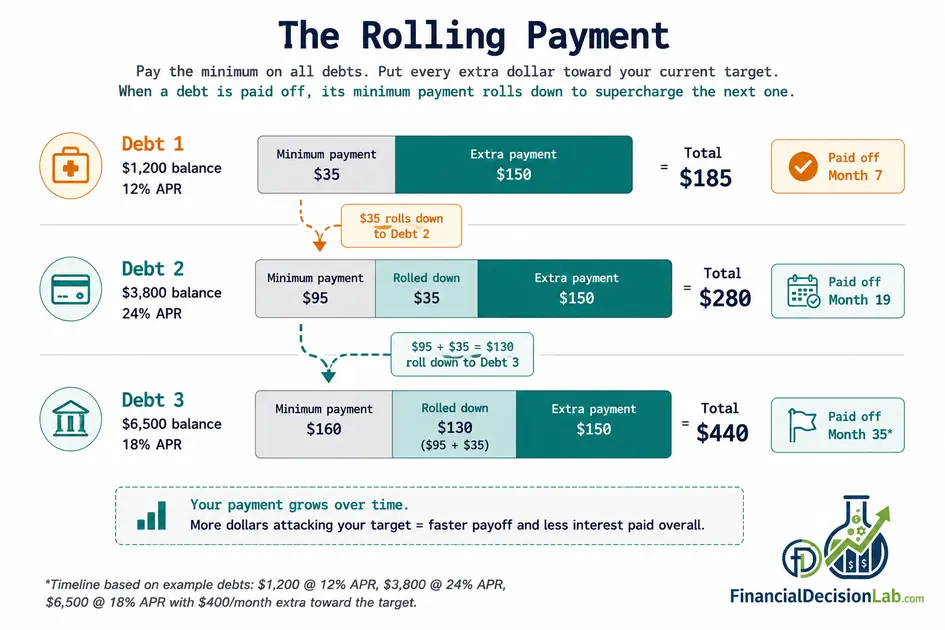
The mechanic is the same for both. Pay the minimum on every debt except one target, put every extra dollar on that target, and when it’s gone, add its old minimum payment to your extra-payment budget for the next target. The only difference is how you sort the list.
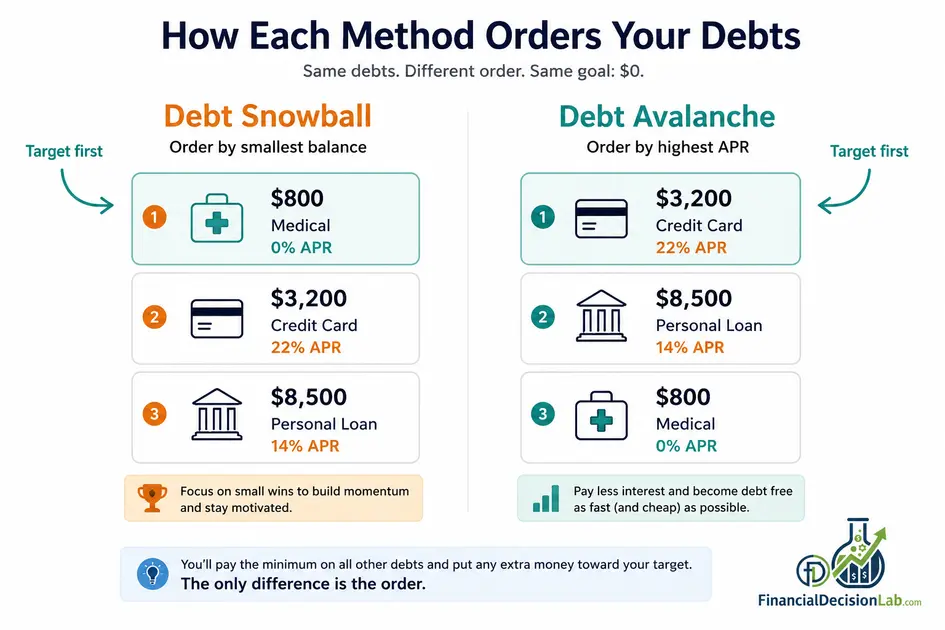
Debt snowball: smallest balance first. Interest rates don’t factor into the order. With an $800 medical bill at 0%, a $3,200 card at 22% and an $8,500 personal loan at 14%, the snowball targets the $800 bill — the fastest account you can close.
Debt avalanche: highest APR first. Balances don’t factor into the order. On the same three debts, the avalanche targets the $3,200 card at 22%. Card issuers calculate interest daily on your average daily balance, so the highest-rate balance is the one growing fastest while you pay everything else. Taking it out first stops the most expensive interest soonest.
Snowball vs. Avalanche on a Real Debt Stack
Here’s a three-debt example where the two methods pick different targets. The rates are realistic: the Federal Reserve’s G.19 consumer credit release put the average rate on credit card accounts that were charged interest at 22.15% in the second quarter of 2026.
- Debt A: $1,200 low-rate card, 12% APR, $35 minimum
- Debt B: $3,800 credit card, 24% APR, $95 minimum
- Debt C: $6,500 personal loan, 18% APR, $160 minimum
- Extra payment budget: $150/month above minimums
| Debt Snowball | Debt Avalanche | |
|---|---|---|
| Payoff order | A → B → C | B → C → A |
| Months to debt-free | ~35 months | ~35 months |
| Total interest paid | ~$3,655 | ~$3,344 |
| Interest saved vs. min-only | ~$4,145 | ~$4,456 |
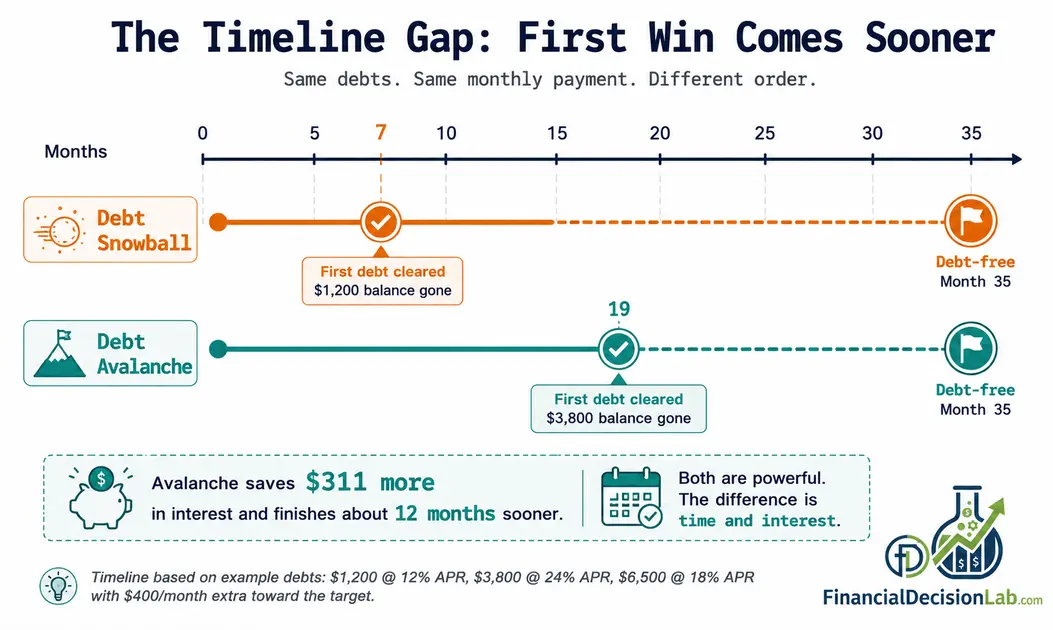
| First debt cleared | Month 7 (Debt A — $1,200) | Month 19 (Debt B — $3,800) |
| Psychological difficulty | Lower | Higher |
| Best for | Motivation risk | Pure math optimization |
The avalanche saves about $311 more. The snowball clears its first account at month 7; the avalanche doesn’t clear one until month 19, because its first target is a larger balance. Both finish in about 35 months. The bigger your high-rate balance is relative to everything else, the wider the avalanche’s lead gets.
Run your own debts through the calculator below. It’s preloaded with this example.
Debt Payoff Calculator
Snowball vs. Avalanche — Your Numbers
Enter your debts and monthly extra payment. The calculator runs a month-by-month simulation for three strategies and shows exact payoff timelines, total interest, and savings versus minimum payments only.
Want to Lower the APR Before You Start?
A personal loan at a lower rate reduces the interest cost under either method. Check options without affecting your credit score.
See If You Qualify for a Lower RateWhy the Snowball Gets Finished More Often
The avalanche’s weakness isn’t the math — it’s month 12 with nothing closed yet. In the example above, someone on the avalanche makes 18 months of extra payments before a single account disappears.
That matters more than it sounds. A study of debt-settlement clients in the Journal of Marketing Research (Gal and McShane, 2012) found that people who closed out more of their individual accounts were more likely to go on to eliminate their debt entirely — regardless of how many dollars they had paid off. Closing accounts, not just shrinking balances, is what predicted finishing. The snowball is built to produce exactly that: a $0 balance as early as possible.
The plan that runs for 18 months beats the optimal plan that stops after four.
Setting Up Your Payoff Plan
1. List every debt in one place. Creditor, balance, APR and the contractual minimum payment — the number below which you’d get a late fee, not a round number you chose. Your statements and online accounts have all four.
2. Find your real extra-payment number. After housing, groceries, utilities and every minimum, what’s left? Even $75 a month on one account changes the math. If that number is close to zero, a seven-step monthly budget walks you from take-home pay to the exact surplus, and the 50/30/20 rule shows why the debt bucket gets squeezed when essentials take more than half your pay.
3. Keep a small buffer. If you have no savings at all, set aside a first $500 before sending every extra dollar to debt. Otherwise one car repair puts the balance right back on a card. Here’s how to build a starter emergency fund while carrying debt.
4. Sort the list and start. Snowball: smallest balance at the top. Avalanche: highest APR at the top. Minimums everywhere else, all extra on row one. When it hits zero, add its old minimum to your extra payment and move down a row. Put raises and windfalls straight onto the current target.
On the avalanche, track the interest charge on your target each month — watching it fall is the avalanche’s version of a quick win. If motivation dips during a long slog, it’s fine to clear one small balance as a detour, then return to rate order. The interest cost of that detour is usually small; the cost of quitting is not.
Re-sort when things change — a new debt, an income drop, a balance transfer. The method stays the same; the order updates.
Lowering the APR Speeds Up Either Method
Both methods assume your rates are fixed, but they don’t have to be. In the same Federal Reserve G.19 release, the average 24-month personal loan rate was 11.86% in Q2 2026 — roughly half the average rate on cards that charge interest. Moving a 22–26% card balance to a lower-rate loan doesn’t change which method you use; it lowers the interest cost for the whole time you’re running it. On the snowball, it shrinks the penalty for ignoring rate order. On the avalanche, it brings your first payoff closer.
The catch: it only helps if your new rate is actually lower and the cleared cards don’t fill back up. Using a personal loan to pay off credit card debt covers the break-even math.
See if a personal loan rate beats your current credit card APR — compare options in under 2 minutes. → Check loan options
Frequently Asked Questions
Which method saves more money overall?
The avalanche always wins on interest saved, because it removes the most expensive balance first. The snowball can still produce a better real-world result if it keeps you from quitting. A study of debt-settlement clients published in the Journal of Marketing Research found that people who closed out more individual accounts were more likely to eliminate their debt, regardless of how many dollars they had paid off — which is exactly the effect the snowball is built to produce. The useful question isn't "which method saves more interest?" but "which method will I actually finish?"
What if two debts have similar balances and similar interest rates?
If the balances and rates are within 10–15% of each other, the ordering decision makes almost no mathematical difference. Pick the one with the marginally higher APR if you want to be precise. One useful exception: if one of the debts has a fixed end date — say, a car loan with 18 months remaining — clearing it first frees the minimum payment sooner, even if the rate is slightly lower.
Can I switch from one method to the other mid-way?
Yes — with one condition. Don't switch mid-cycle on your current target debt. Finish the payoff you've already started, then re-sort your remaining list using the new method's ordering logic. Switching midstream on a target debt means you've paid down a balance without completing the win, which is the worst outcome of both methods.
What if I have a mix of very high-rate and very high-balance debt?
High-rate, high-balance debt is where the two methods diverge most sharply — and where ignoring rate order has a real dollar cost. A $12,000 credit card balance at 28% APR generates roughly $280 per month in interest at minimum payment. At that level, the interest cost of ignoring rate order is no longer a rounding error — it's a material drag on everything else you're doing. Run the calculator to see the exact monthly interest on your high-rate balance. That number alone usually makes the decision.
Is it worth including car loans and student loans in my payoff plan?
List them for a complete picture, but treat them differently from credit cards. Federal student loans carry income-driven repayment options and potential forgiveness programs that change the calculus. Car loans are fixed-term and often lower-rate. For most people, credit card and high-rate personal loan balances in the 18–28% APR range are the highest-yield targets by a significant margin. Focus extra payment dollars there first.
How do I start paying down debt when I can only afford minimums?
Minimum-only payments aren't a neutral holding pattern — on a high-rate card, they can keep you in repayment for a decade or more (here's why the balance moves so slowly). If there's genuinely no room for extra payments, the first step is finding it — a subscription audit, a temporary spending pause on a single category, or a one-time income source. Even $30 to $50 above minimums on one account changes the math materially. For a path that starts before the payoff method choice — hardship programs, assistance programs, and creating margin first — see how to get out of debt when you're broke.
Does it matter which card I pay off first if I'm also doing a balance transfer?
Yes, and this interaction is often overlooked. A balance transferred to a 0% intro APR card temporarily exits the avalanche order — its effective rate is 0% during the promotional period. Your avalanche target becomes the next-highest rate on your remaining list. Re-sort your debt list after every transfer and again when the intro period expires. A 0% card reverting to a 24% regular APR needs to re-enter the avalanche at the top of your list. For a deeper look at when a balance transfer makes more sense than consolidation, see debt consolidation vs. balance transfer.
What if one of my debts is in collections?
A collections balance doesn't slot naturally into either method. There's often no "minimum payment" in the traditional sense, and the balance may be negotiable — sometimes significantly. Before folding a collections account into your payoff plan, verify the balance and its age, confirm the debt is yours, and check whether it's within your state's statute of limitations for collections. If it is, negotiate a settlement amount directly before or alongside your regular payoff plan. If several accounts are already past due, debt settlement vs. consolidation compares what each route costs. A collections account handled separately is not a failure of your method — it's a parallel process.