

- Why being broke fundamentally changes which debt strategies work — most advice assumes extra money you don't have, which is why following it feels impossible.
- Who this hits hardest: people whose paycheck is gone once rent, utilities, food and minimum payments are covered — and why that group needs to create margin before choosing any payoff strategy.
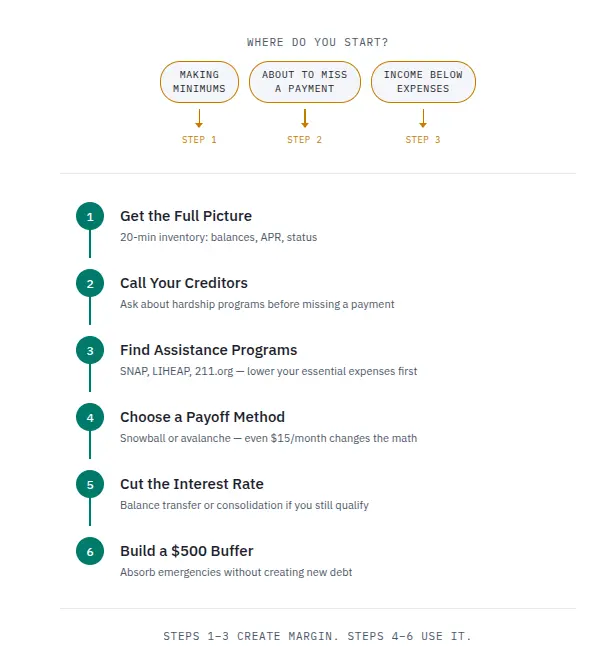
- Six concrete steps ordered by what to do first — starting with what costs nothing and working toward options that require credit qualification.
When there’s nothing left after rent, utilities, food and minimum payments, getting out of debt starts with creating margin, not paying extra: call your creditors about hardship terms before you miss a payment, and lower your essential costs through programs like SNAP and LIHEAP. Once even $10–$20 a month is freed up, a payoff method and a lower interest rate can start doing real work.
Standard debt advice is written for people who have breathing room. “Pay extra on your highest-rate card.” “Throw your bonus at the balance.” For someone whose income is fully committed before the month starts, that advice doesn’t land. It just reminds you what you don’t have.
If you’ve searched something like “how do I get out of debt when there’s nothing left at the end of the month” — this is exactly what this article is about.
This article covers three real situations: you’re making all your minimums but can’t add a single dollar more; you’re starting to slip on one or two payments; or your income is structurally below what it costs to live, let alone pay down anything. There are real paths out of each — but the order you take steps in matters. Most people try to start at step four when steps one through three are what actually unlock forward movement.
Which situation fits yours?
Making minimums but nothing extra → Follow steps 1–4 in order; steps 5–6 once you’ve freed up some margin.
Already missing or about to miss a payment → Jump to Step 2 immediately, then Step 3 for income-side relief.
Income consistently below essential expenses → Start at Step 3 before anything else, then return to Step 2.
Why Most Debt Advice Doesn’t Apply When You’re Broke
“Put extra toward your highest-rate card” is genuinely good advice — for someone who has extra. Telling someone running at zero to throw extra money at debt is like telling someone who can’t afford groceries to just meal prep. Technically sound. Practically useless.
The minimum payment trap: at 20% APR, a $100 payment on a $5,000 balance sends roughly $83 to interest and only $17 to principal. Card issuers calculate interest daily on your average daily balance, so when you carry a balance, most of a small payment goes to that month’s interest first.
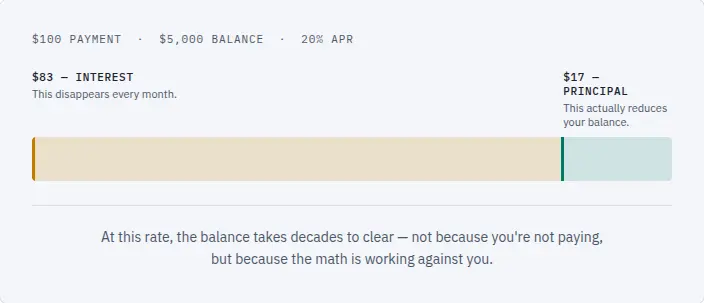
That’s why paying the minimum on time, every month, can still leave you owing almost the same amount a year later. For the full math, read why your credit card debt isn’t going down.
Being in debt and broke at the same time is not a character flaw. It’s a specific financial position with specific solutions.
Step 1: Get the Full Picture Before You Touch Anything
Before any strategy, you need an inventory. Most people in this situation avoid looking at the total — it’s a natural instinct. But you can’t make decisions in the dark, and the picture is usually more manageable once it’s on paper rather than living as a vague dread in the back of your mind.
Spend 20–30 minutes building a simple list: creditor name, current balance, APR, minimum payment, and payment status (current, 30 days late, or in collections). This costs nothing and immediately tells you two things — which debts are most urgent, and which carry the highest interest. Those are often different debts requiring different responses. Once the debt list exists, the next layer is placing it inside the full monthly picture: a seven-step monthly budget from scratch maps take-home pay against every committed cost and shows exactly what the surplus or deficit is — which determines whether any extra payment is possible at all, and how much.
Pull your free credit report from AnnualCreditReport.com — the only federally authorized source, now offering free weekly reports from all three bureaus. Check for anything in collections you may have lost track of. A debt in collections operates on a different timeline and requires a different approach than active revolving debt. If anything has already gone that route, read what happens when you stop paying credit card debt for the full timeline and your options at each stage.
Step 2: Call Your Creditors — Before You Miss a Payment
Most major credit card issuers have hardship programs. Temporary APR reductions — sometimes to 0%. Reduced minimums for three to six months. Payment deferrals. These programs exist, they’re used regularly, and they are almost never advertised. You have to ask.
The key condition: call before you miss a payment. Once you go 30 days delinquent, some of these options close. A single proactive call while you’re still current gives you significantly more leverage.
What to say: “I’m experiencing financial hardship and want to discuss my options before I miss a payment.”
What they may ask: Your income, monthly expenses, or how long you’ve been a customer. Answer honestly and briefly — you don’t need to justify or over-explain.
If they say no hardship program is available: Ask to be transferred to the hardship or financial assistance department specifically — front-line agents often don’t have full visibility into all programs. If still no, ask: “Can you reduce my interest rate or minimum payment temporarily?” and get a callback number for a supervisor.
What this buys you when it works: time, credit score protection, and sometimes a meaningfully lower interest rate for several months. If you’ve already missed one payment, it’s not too late — call immediately. Read what to do when you miss a credit card payment to understand your options in that window.
If you’d prefer professional support, the National Foundation for Credit Counseling (NFCC) connects you with nonprofit credit counselors at low or no cost. They can negotiate with creditors on your behalf.
Step 3: Find Out If You Qualify for Programs That Lower What You Owe Each Month
If essential bills are consuming all your income, faster debt payoff isn’t possible until those bills go down. That’s not a budgeting problem — it’s a structural gap between income and essential costs, and there are programs that exist specifically to close it.
A lot of people skip this step because looking for assistance feels like admitting something. That instinct is understandable and also expensive. These programs exist because this gap is common, documented, and recognized by governments and nonprofits as something that requires structural solutions — not willpower. Using them when you qualify is exactly what they’re built for. You’ve already paid into many of these through taxes.
Here’s what’s available and what each one actually does to your monthly number:
Utilities — LIHEAP (Low Income Home Energy Assistance Program): Reduces heating and cooling costs for qualifying households. Typical benefit: $200–$1,000 per year depending on your state and household size — applied directly to your energy bill. Apply through HHS/LIHEAP or check your state’s benefit levels at the LIHEAP Clearinghouse.
Food — SNAP (Supplemental Nutrition Assistance Program): For a single person, the average SNAP benefit is roughly $180–$200 per month. If your grocery budget is $350, that’s $180 freed each month — money that can now go toward debt instead. Every dollar SNAP covers is a dollar that doesn’t come out of your paycheck.
Housing — Emergency Rental Assistance: If you’re behind on rent, HUD emergency rental assistance offers a state-by-state directory of programs that can cover arrears and prevent eviction — removing what is often the single largest stressor in this situation.
Phone and internet — Lifeline: Reduces monthly phone or internet costs by up to $9.25/month ($34.25/month on qualifying Tribal lands) for eligible households. A smaller subsidy than some expect, but it’s a permanent program — every consistent reduction counts when you’re building margin.
Childcare, medical, prescriptions: State-level programs vary significantly. Don’t assume you don’t qualify without checking — income thresholds are higher than most people expect.
The fastest way to see what you’re eligible for — without calling ten agencies — is 211.org. Enter your zip code and get a matched list of local and federal programs. Free. No commitment.
Check What You Qualify For — Free
Our Financial Help Finder does the same at the national level — a free tool that matches you to federal, state, and nonprofit assistance programs based on your household situation, income, and location. No application required to check what you qualify for.
See What's Available →Once essential expenses drop through any of these programs, margin appears. Even $20 or $30 a month. That’s when Step 4 becomes possible.
Step 4: Choose a Payoff Method That Works Even With Very Little Extra
Figuring out how to get out of debt with no money often comes down to understanding what even a small extra payment actually does. The answer is more than most people expect.
On a $3,000 balance at 22% APR, adding $25/month above your minimum reduces payoff time from over 11 years to under 4 years — and saves more than $1,800 in interest.
The calculator below lets you use your own numbers — plug in your actual balance and rate to see how much your payoff timeline shifts.
Payoff Comparison Calculator
Minimum only
Minimum + extra
Where that extra $15–30 should go depends on your situation:
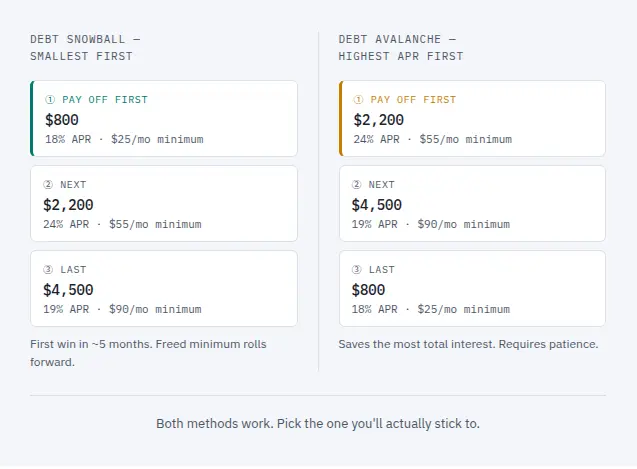
Debt snowball (smallest balance first): Better when motivation is the bottleneck. Paying off a small balance frees its minimum payment to roll forward to the next debt — creating momentum that makes larger balances feel more approachable.
Debt avalanche (highest APR first): Mathematically optimal. You pay less total interest over time. Works best if you can stay consistent without quick wins. Our debt snowball vs. debt avalanche comparison walks through examples for both so you can see which math fits your balances.
What 18 months looks like in practice: If Step 3 frees up $30/month and you put it toward your smallest balance while calling creditors for a temporary rate reduction in Step 2, a $1,200 balance at 24% APR can be gone in roughly 14 months — minimum payment freed, applied to the next balance. The numbers don’t require a windfall. They require direction.
Your starter plan:
- List your balances — smallest to largest (snowball) or highest APR first (avalanche)
- Set up a recurring transfer of your extra amount to that debt on payday — even $15 counts
- When the first balance hits zero, add that freed minimum to the next debt automatically
If you genuinely can’t free up even $10 extra per month, revisit Step 3 first. You can’t implement a payoff method on a budget with no room. The minimum payments explainer shows exactly why the direction of even small extra payments changes the trajectory.
Step 5: If Your Credit Still Qualifies, Cut the Interest Rate
When APR sits at 22–29%, the majority of every minimum payment evaporates into interest before it touches your balance. Lowering the rate changes how much of each dollar actually reduces what you owe.
Two realistic paths:
Balance transfer at 0% intro APR: Moves your existing balance to a card charging no interest for a promotional period — typically 12 to 21 months. Usually requires a credit score of 670 or above, and the balance should be payable within that window. See debt consolidation vs. balance transfer for when each approach makes sense.
Personal loan consolidation: Replaces high-rate revolving debt with a fixed lower-rate installment loan. Predictable monthly payments, typically lower APR, and a defined payoff date. Consolidating credit card debt with a personal loan walks through when this makes financial sense.
If your credit has already taken hits from missed payments, these options may be unavailable for now. Debt management plans through NFCC counselors or debt settlement become the conversation — both carry different trade-offs, detailed in debt settlement vs. debt consolidation.
High-Rate Debt Eating Your Payments?
If you still qualify, a consolidation loan at a lower rate restructures what you owe at a fixed payment — and changes how much of each dollar reduces the balance rather than feeding the interest. Checking your rate doesn't affect your credit score.
Check Your Rate — No Credit Impact →Step 6: Build a $500 Buffer — The Minimum That Breaks the Cycle
The debt cycle repeats because every unexpected expense — a car repair, a medical copay, a utility shutoff notice — goes on a card. A $500 emergency buffer absorbs the most common financial shocks without creating new debt.
At $20 per week, you reach $500 in 25 weeks. At $50 per week, you’re there in 10. The simplest way to make it happen: set up an automatic transfer — even $10 — to a separate savings account on every payday. Label it something distinct from your regular savings so you don’t touch it. Not in checking where it disappears into ordinary spending.
Our guide to building an emergency fund covers where to keep it, what counts as a real emergency, and how to rebuild after you use it.
This step comes last deliberately. It only works once steps 1–5 have created some monthly margin. Trying to save a buffer while still in the debt spiral is filling a bucket that still has holes.
Which Steps Come First: Minimums Only, Falling Behind, or Short Every Month
Path A — Making minimums but nothing extra: Step 1 (inventory) → Step 2 (call creditors for hardship terms) → Step 4 (minimum-plus payoff). Once one balance hits zero, roll that freed minimum into the next debt. Progress accelerates with each payoff.
Path B — Already missing or about to miss a payment: Go directly to Step 2. Call before the 30-day mark if at all possible. Then Step 3 to address the underlying income/expense gap. Read what happens when you stop paying credit card debt to understand the timeline from here.
Path C — Income consistently below essential expenses: Start with Step 3. Check 211.org and Financial Help Finder. Until the gap narrows, debt payoff is secondary to stabilizing the basics. Once the gap closes, return to Step 2 and Step 4.
Frequently Asked Questions
I have no income right now — what can I actually do about my debt?
With zero income, you have zero capacity to service debt — and that's the honest starting point. Priority becomes stabilizing income first: SNAP, unemployment insurance, and local assistance programs. Hardship forbearance through your creditors can pause or reduce payments as a bridge. 211.org and the NFCC are both free starting points for mapping what's available in your area.
I can't make my minimum payment this month — what do I do first?
Call your creditor today — not after you miss the payment. Explain hardship and ask specifically about hardship programs, temporary rate reductions, or payment deferrals. If they say no, ask to speak with the hardship department specifically. A nonprofit credit counselor through the NFCC can also negotiate on your behalf. Read what happens when you stop paying credit card debt so you understand what the timeline looks like from here.
Does calling my credit card company to ask for help hurt my credit score?
No. A phone call doesn't appear on your credit report. Only missed payments — once they hit 30 days late — damage your score. Calling proactively before you miss anything is the right move.
I'm thinking about stopping payments on one card to pay off another faster — is that a mistake?
Almost always yes. Deliberately defaulting on one account triggers fees, a penalty APR increase, and eventually collections or legal action on that account. The compounding costs usually outweigh the short-term cash freed up. See what happens when you stop paying credit card debt for the full picture.
I called my creditor and they said no hardship program is available — what now?
Ask to be transferred to the hardship or financial assistance department specifically — front-line agents often don't have full visibility into available programs. If that still returns nothing, get a supervisor's callback number and call again in a few days. Simultaneously, contact the NFCC — their nonprofit counselors can sometimes negotiate access to programs that individual callers can't reach on their own.
I qualify for SNAP or other assistance but feel embarrassed to apply — is it worth it?
Yes. These programs exist because the income-to-expense gap you're in is common and documented — not a personal failure. For someone with $350/month in grocery spending, SNAP can free $180+ per month. That's not charity; it's a structural tool you've already contributed to through taxes. The fastest way to check what you qualify for without committing to anything: 211.org or our Financial Help Finder (linked earlier in this article).
What's the difference between debt consolidation and debt settlement when you have no money?
Consolidation restructures what you owe at a lower rate — you repay the full amount, just more efficiently. It requires qualifying for credit. Settlement negotiates a reduced payoff, typically after significant delinquency, and causes serious credit score damage. If you're still current, consolidation almost always produces the better long-term outcome. Full breakdown: debt settlement vs. debt consolidation.
How long does it realistically take to get out of debt on a low income?
It depends on total balance, APR, and monthly capacity. Example: $8,000 at 22% APR with a fixed $250/month payment takes roughly 4 years and generates about $4,200 in interest. Adding $50/month cuts that to about 3 years and saves roughly $1,100 in interest. The math is slow, but not infinite — and every step that lowers your rate or raises your payment shortens it.
Is bankruptcy worth considering if I genuinely can't pay?
In some situations, yes — particularly when total unsecured debt exceeds roughly 40% of annual income (a common rule of thumb, not a legal threshold) and there's no realistic repayment path. Chapter 7 discharges most unsecured debt in four to six months. It's a legitimate legal tool, not a last resort for failures. The U.S. Courts bankruptcy basics page explains both Chapter 7 and Chapter 13 in plain language. If this feels like your situation, an initial consultation with a bankruptcy attorney is the logical next step — many offer free first consultations.