
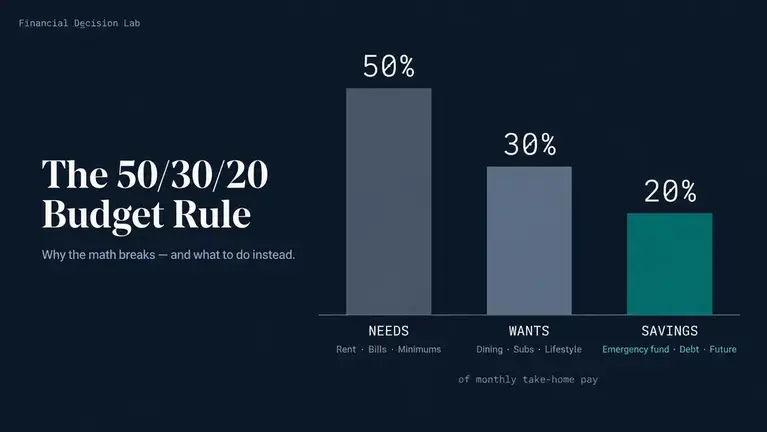
- What the 50/30/20 budget rule is — 50% of take-home pay to needs, 30% to wants, 20% to savings and extra debt — and why it often breaks in practice.
- Who gets hit hardest by the rule's math: renters, debt carriers, and anyone whose essential expenses already exceed half their take-home pay — before the month even starts.
- What "adapting the percentages" actually means in structural terms — and the specific fix for each scenario where the standard split stops working.
The 50/30/20 budget rule splits your monthly take-home pay into three buckets: 50% for needs, 30% for wants, and 20% for savings and extra debt payments. On $4,000 a month after taxes, that’s $2,000 for needs, $1,200 for wants and $800 for savings and debt paydown.
The rule is simple to set up, and that’s why it’s so widely cited. It’s also widely abandoned, because the 50% needs ceiling assumes housing costs that many people no longer have. The Census Bureau reports that 49.7% of renter households spent more than 30% of their income on housing in 2023. For those households, rent alone takes most of the needs bucket before utilities, groceries or a single minimum payment.
Run your own numbers below, then read on for which income figure to use, where debt payments go, and how to adjust the split when it doesn’t fit.
50/30/20 Budget Calculator
See Your 50/30/20 Numbers
Enter your monthly take-home pay — the amount deposited after taxes and deductions. The calculator shows your target dollar amount for each bucket. Toggle "Adjust the split" to use your own percentages.
Which version is right for you?
→ Your income comfortably covers rent, bills, and minimum payments — apply the rule as written. Start with the definition below, then skip to Setting Up the 50/30/20 Split on Payday.
→ Essential expenses eat more than 50% of your take-home — the rule needs structural adjustment. Jump to Why the Math Breaks for Most People — that’s where this article gets useful for you.
→ High-interest debt is consuming your budget before you spend anything on lifestyle — the problem isn’t the rule, it’s the interest rate. Jump to How to Adapt the 50/30/20 Rule.
What Is the 50/30/20 Budget Rule?
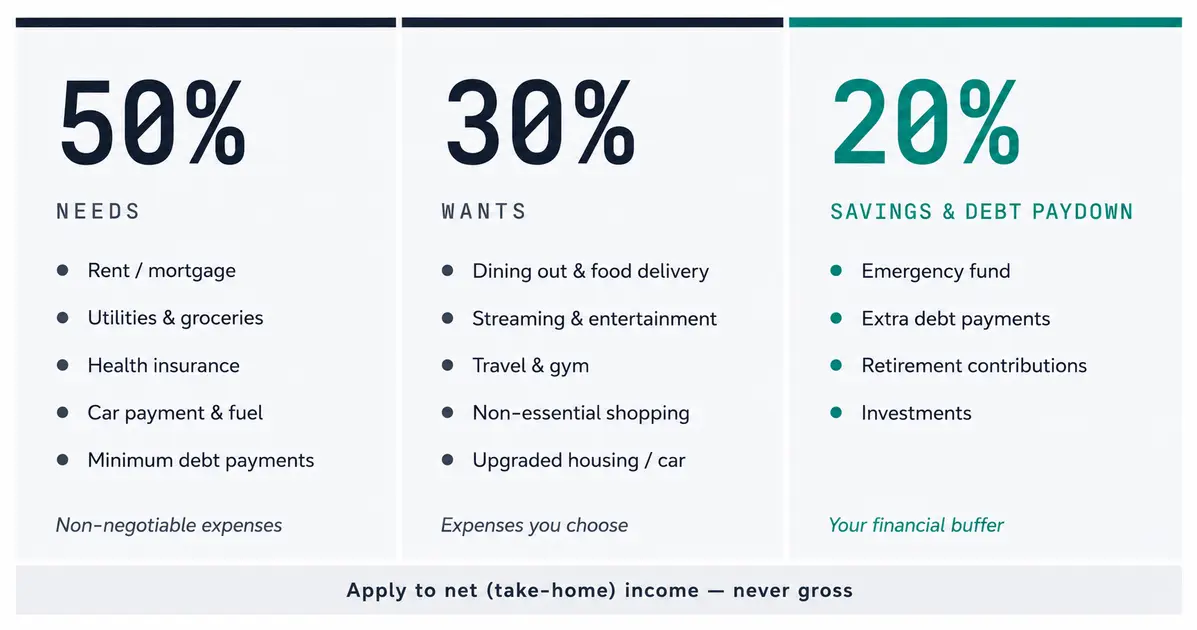
The 50/30/20 rule is a percentage-based budgeting framework created by Senator Elizabeth Warren and her daughter Amelia Warren Tyagi in their 2005 book All Your Worth. The idea: divide your monthly take-home pay into three fixed buckets.
| Bucket | Percentage | What belongs here |
|---|---|---|
| Needs | 50% | Rent/mortgage, utilities, groceries, insurance, loan minimums |
| Wants | 30% | Dining out, subscriptions, entertainment, non-essential shopping |
| Savings / Debt paydown | 20% | Emergency fund contributions, retirement savings, extra debt payments |
The appeal is simplicity. No spreadsheet required, no tracking every transaction. Set the three buckets, automate the splits, check in quarterly.
The limitation is that the rule was designed for a median income in 2005. Housing costs, insurance premiums, and minimum debt burdens have all shifted significantly since then. The framework is sound; the percentages are optimistic.
Gross or Net — Which Income Figure Do You Use?
Always apply the 50/30/20 rule to net (take-home) income — the amount that actually lands in your bank account after taxes, Social Security, and any pre-tax deductions come out. Social Security and Medicare alone take a combined 7.65% of most employees’ wages before income tax is counted.
Using gross income inflates every bucket by 15–30% and produces a budget that’s already negative before you spend a dollar. If your employer withholds $900/month in taxes and you budget off your gross salary, you’re working with money you never actually receive.
If your income varies — freelance work, hourly wages, tips, commission — don’t use your best month or your average. Use a floor figure instead (see Scenario 3 below).
Why the 50/30/20 Rule Breaks for Most People
Most articles explain what the rule is. Very few address why it fails for the majority of people who search for it. That’s the real question behind “does the 50/30/20 rule work” — not what the rule is, but whether it actually applies to a real person in today’s economy.
1. Housing alone exceeds the needs ceiling.
The 50% needs budget has to cover rent, utilities, food, insurance, and all minimum debt payments combined. Housing is the biggest line by far: in the Bureau of Labor Statistics’ 2024 Consumer Expenditure Survey, housing took 33.4% of the average household’s total spending. Renters who spend more than 30% of income on housing are counted as cost-burdened, and as noted above, nearly half of renter households are past that line.
This isn’t a discipline problem. It’s a cost-of-living problem. A rule that leaves 50% for every need combined doesn’t have much room when one need takes a third or more.
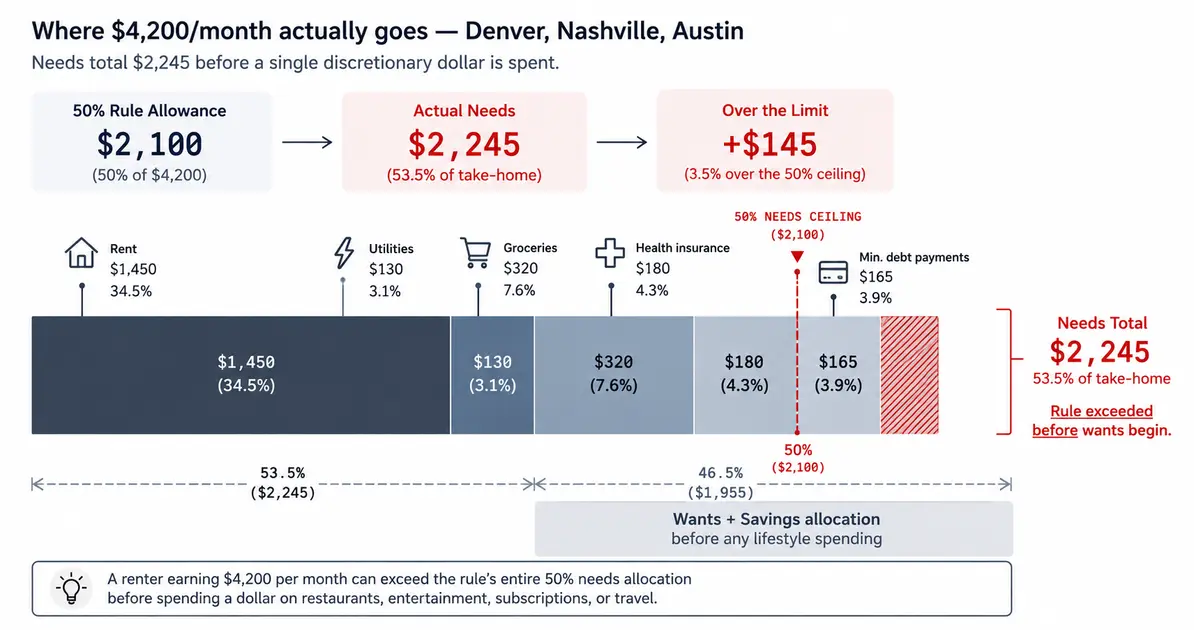
Here’s what it looks like in practice: someone earning $4,200/month take-home in a mid-cost city — Denver, Nashville, Austin — pays $1,450/month in rent. That’s 34.5% of take-home before anything else. Add $130 in utilities, $320 in groceries, $180 in health insurance premiums, and $165 in minimum debt payments, and their needs total $2,245 — 53.5% of take-home. The ceiling was crossed before they spent a dollar on anything discretionary. That’s a common story, not an outlier.
2. Minimum debt payments absorb what should be discretionary.
Take a $6,000 credit card balance at 22% APR. That rate isn’t unusual: the Federal Reserve’s G.19 consumer credit release puts the average rate on card accounts that are charged interest at 22.36% (August 2026). Minimum payments on that balance run $150–$180 per month. That’s classified as a need — you can’t skip it. But it means the 30% wants bucket starts $150–$180 lighter before you’ve spent anything on lifestyle.
3. The rule assumes income stability the gig economy has eliminated.
Variable income earners — freelancers, hourly workers, people earning tips or commission — have no guaranteed monthly baseline. A framework built on fixed percentages becomes guesswork when the denominator changes every month.
The honest framing: The 50/30/20 rule is most useful as a diagnostic tool, not a rigid mandate. If your needs consistently exceed 50%, the rule has told you something real: either income needs to rise, essential costs need to fall, or both. That’s not failure — that’s information.
How to Adapt the 50/30/20 Rule When It Doesn’t Fit
Adjusting the percentages isn’t abandoning the framework — it’s applying it honestly to your actual situation.
Scenario 1: Needs exceed 50%
Reframe temporarily as 70/20/10 — 70% needs, 20% wants, 10% savings. This is a transitional split, not a permanent one. Track what’s actually happening before making cuts. Once you can see which specific need is overrunning the budget (almost always housing or minimum debt payments), you can address the root cause rather than trimming $15/month from subscriptions.
Scenario 2: Debt minimums are the ceiling-blower
If minimum payments alone push needs past 50%, the interest rate — not the balance — is often the root problem. A $6,000 balance at 22% APR carries a minimum of roughly $170/month. The same balance consolidated into a personal loan at 9% APR runs roughly $125/month on a 60-month term — a fixed payment, not a revolving minimum. That $45 monthly reduction changes the entire budget structure.
Lowering the rate through a balance transfer or personal loan consolidation can bring the needs bucket back below 50% without cutting a single expense.
Scenario 3: Income is irregular
Use a floor income — the lowest monthly net deposit you’ve received in the past six months. Build the budget around that conservative figure. In months when income exceeds the floor, route the surplus directly to the 20% bucket: emergency fund first, then debt paydown. Don’t adjust lifestyle spending upward based on a good month.
Scenario 4: You’re newly starting out
Use the rule directionally, not numerically. Before changing anything, track what percentage of take-home is going to each bucket for 30 days without altering your behavior. The honest baseline is more valuable than any percentage target — it shows you where the real problem is before you try to fix it. For readers building a budget for the first time, a seven-step monthly budget from scratch walks through the exact process — from calculating real take-home through every cost category to the final surplus or deficit — before any percentage targets come into play.
What Goes in the 50% “Needs” Bucket?
Needs are expenses you cannot reasonably eliminate without a significant change in circumstances. The rule draws a hard line at 50% of take-home for this category.
Counts as a need:
- Rent or mortgage payment
- Utilities (electricity, water, gas, internet if required for work)
- Groceries — not restaurants, not food delivery
- Health insurance premiums and required copays
- Car payment and fuel (if the car is required for work)
- Minimum payments on all debts (credit cards, student loans, personal loans)
- Childcare required for work
Does not count as a need:
- Streaming subscriptions
- Gym membership
- Dining out or food delivery
- Clothing beyond basics
- Any debt payment above the minimum
That last point is important. The minimum payment on your credit card is a need — the cost of avoiding default, late fees, and credit damage. But any payment above the minimum is a choice. Extra debt paydown is discretionary and lives in the 20% bucket, not here.
Essential Costs Exceeding 50%?
If essential needs — rent, utilities, groceries, insurance — consistently push past 50% of take-home pay, that's a structural income/expense gap, not a budgeting failure. Financial assistance programs at the federal, state, and nonprofit level exist specifically to address this gap. Free to search, no purchase required.
See What's Available →What Goes in the 30% “Wants” Bucket?
Wants are expenses you choose — not survival costs. The practical question for most people isn’t “what counts as a want?” It’s “why does my 30% bucket feel empty before I’ve bought anything?”
The answer is usually debt. Minimum payments live in the needs bucket — they’re not optional. But when you’re paying above the minimum on credit card balances, that extra payment belongs in the 20% bucket, not here. Which means the wants bucket actually has more room than it appears — unless the interest rate has driven the minimum itself so high that it’s draining the needs ceiling.
What counts as a want: restaurants and food delivery, streaming services, entertainment, clothing beyond essentials, travel, gym memberships, non-essential subscriptions, and any housing or car upgrade beyond what the basic need requires.
If minimum debt payments are eating into the wants allocation before you’ve spent anything on actual wants, the problem isn’t your lifestyle — it’s the interest rate compounding against you every month. A $6,000 balance at 22% APR costs roughly $110/month in interest alone. At 9% APR, that drops to $45. The $65 monthly difference currently disappears before you buy groceries, let alone anything discretionary.
High-Rate Debt Eating Your Budget?
A lower-rate personal loan consolidates that balance into a fixed monthly payment, reducing how much bleeds out each month and giving your wants and savings buckets room to breathe. Checking your rate doesn't affect your credit score.
Check Your Rate — No Credit Impact →What Goes in the 20% “Savings and Debt Paydown” Bucket?
The 20% bucket has two jobs: building financial buffer and eliminating debt faster than the minimums require. The order you tackle those two things matters.
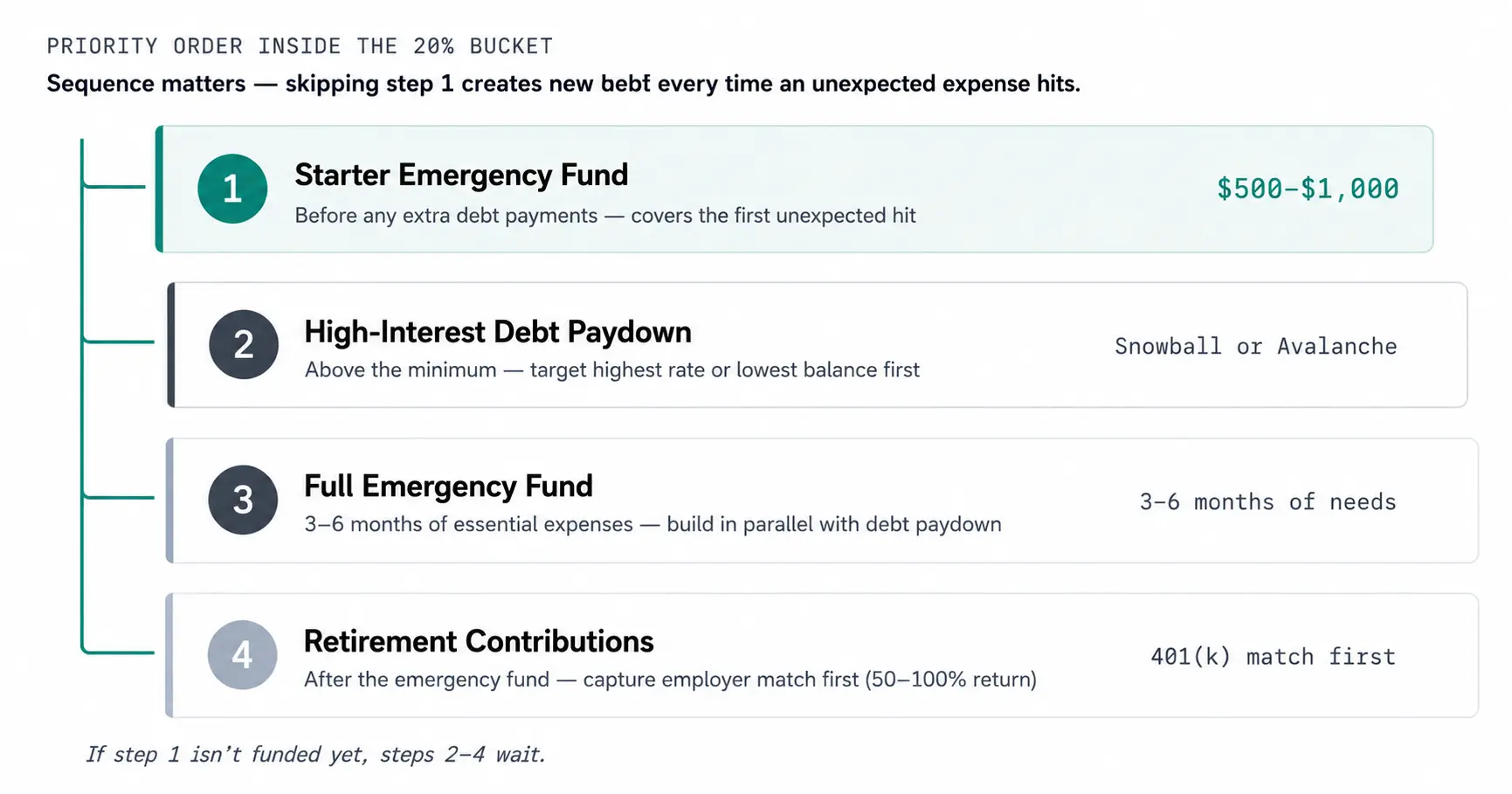
Priority order inside the 20% bucket:
- Starter emergency fund — $500–$1,000 first, before extra debt payments. Without this cushion, every unexpected expense creates new debt and resets your progress.
- High-interest debt paydown above minimums — once the starter fund exists, direct extra payments to your highest-rate or lowest-balance debt. See: Debt Snowball vs. Avalanche.
- Full emergency fund — 3–6 months of essential expenses, built in parallel with debt paydown once the starter amount is in place.
- Retirement contributions — after the emergency fund is funded. If your employer offers a 401(k) match, contribute enough to capture the full match even during debt paydown — that match is a 50–100% return. See: Pay Off Debt or Invest First?.
If the 20% bucket feels too thin to do any of this, that’s the signal. The needs or wants buckets need restructuring before savings can grow.
Setting Up the 50/30/20 Split on Payday
Run the calculator above with your actual monthly take-home. Then set up two automated transfers on payday: one to the account that pays your fixed bills, and one that moves your 20% (savings and extra debt payments) to a separate account the moment your deposit clears. The separation is the system — it removes the decision before you have a chance to spend the money.
Check the split once a month for the first three months by sorting your bank transactions into the three buckets. If needs keep landing above 50%, switch to one of the adapted splits above rather than abandoning the framework.
If your budget comes out negative even before wants, a percentage rule can’t fix it — no split works when essentials exceed income. That’s a different problem with its own diagnosis (an income-expense gap versus a debt-cost problem), covered step by step in how to make a monthly budget.
We earn a commission if you apply through links on this page. This doesn’t change our analysis — the 50/30/20 rule and its limitations are covered on their merits.
Frequently Asked Questions
What if my rent alone takes more than 50% of my income?
You're not alone — this is increasingly common in high cost-of-living areas. When rent alone exceeds the entire needs ceiling, the 50/30/20 rule can't function as written. Your options are structural: increase income, reduce housing costs (roommates, relocation, refinancing), or temporarily adopt a higher needs allocation like 70/20/10 while working toward a longer-term fix. Cutting subscriptions won't solve a housing cost problem.
Where do debt payments go in the 50/30/20 rule?
They're split across two buckets. Minimum payments on all debts go in the 50% needs bucket — skipping them isn't optional. Any payment above the minimum goes in the 20% savings/paydown bucket, because extra payments are a deliberate choice, not a requirement. This distinction matters: if you're paying well above minimums, your needs bucket has more room than it looks, and your 20% bucket is doing real work.
Does the 50/30/20 rule work on a low income?
Not in its original form. When essential costs consume 70–80% of take-home pay, no version of the rule produces a 20% savings rate. At lower income levels, the most practical approach is to use the rule as a tracking tool while pairing it with assistance programs that reduce essential costs directly — food assistance, utility relief, and housing programs most households qualify for without realizing it.
Can I adjust the percentages to fit my situation?
Yes — and you should when the standard split doesn't reflect your reality. A 60/25/15 split you actually follow is more effective than a 50/30/20 split you abandon in week two. The principle of deliberate income allocation matters more than the specific numbers. Use the calculator above to see what any custom split produces at your actual take-home pay.
Should I pay off debt or save under the 50/30/20 rule?
Both, in order. Build a starter emergency fund of $500–$1,000 first. Then direct extra money to high-rate debt. Then build a full 3–6 month emergency fund. Skipping the starter fund to accelerate debt paydown is a common mistake — one unexpected expense sends you back to the credit card and erases the progress. For the full math on which move wins by income and interest rate, see Pay Off Debt or Invest First?.
How do I track the 50/30/20 split without a budgeting app?
Pull your bank's transaction history at the end of each month. Sort every expense into needs, wants, or savings. Calculate each category's percentage of your net income. Do this for two to three months before changing anything — the pattern is usually more revealing than any app dashboard. The baseline data tells you where the real problem is before you try to fix it.
What's the real difference between a need and a want?
A need is an expense you cannot eliminate without a significant life change. A want is something you choose. Misclassifying wants as needs is the most common reason the needs bucket overflows. Internet service may be a need if you work from home; a premium streaming bundle is a want. Checking the needs bucket for hidden wants is usually the first productive step when the budget isn't balancing.